



Explore this content with AI
Can you program and automate SMS?
Yes, a programmable SMS API lets you send, schedule, and automate text messages through code.
That way, you can connect your CRM, ecommerce platform, or internal tools directly to the SMS provider instead of managing sends by hand through a dashboard.
(And good news: it can cost as low as $20/month.)
So let’s walk through how the API works, real code examples, what it costs, and how to test it in a single session before committing.
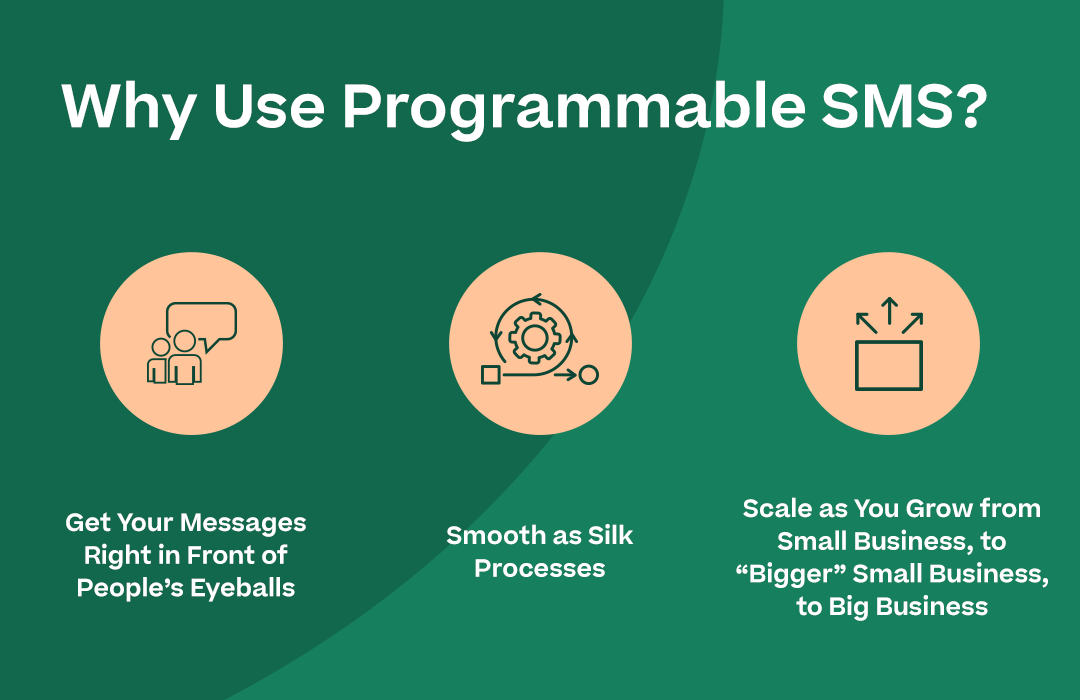
After all, manual texting isn’t sustainable as a business grows. But programmable SMS API can scale as you need it to.
How Does a Programmable SMS API Work?
SMS API
The primary way programmable SMS works is through SMS APIs set up via SMS gateways.
These programmable services are offered by SMS platforms/API services.
The SMS platform will provide you with an API key that you can use to connect to the SMS gateway. In the case of Mobile Text Alerts, this is through a unique API key provided to you for free, included with whatever plan you choose.
API documentation details how to use your API key to set up your programmable SMS.
CODE EXAMPLES:
Sending a Message
cURL
curl --location 'https://api.mobile-text-alerts.com/v3/send' \
--header 'Authorization: Bearer <APIKey>' \
--header 'Content-Type: application/json' \
--header 'Content-Type: application/json' \
--data '{"subscribers": [1112223333], "message": "test1234!"}'
Node.js
const response = await fetch('https://api.mobile-text-alerts.com/v3/send', {
  method: 'POST',
  headers: {
    'Authorization': `Bearer ${process.env.MTA_API_KEY}`,
    'Content-Type': 'application/json'
  },
  body: JSON.stringify({
    subscribers: [1112223333],
    message: 'test1234!'
  })
});

const data = await response.json();
console.log(data);
Python
import requests
import os

response = requests.post(
    'https://api.mobile-text-alerts.com/v3/send',
    headers={
        'Authorization': f'Bearer {os.getenv("MTA_API_KEY")}',
        'Content-Type': 'application/json'
    },
    json={'subscribers': [1112223333], 'message': 'test1234!'}
)
print(response.json())
Example Response
{
  "data": {
    "messageId": "uuid",
    "totalSent": 1,
    "totalFailedInternationalRecipients": 0
  },
  "message": "Message Sent to 1 Recipient."
}
Adding a Contact
cURL
curl --location --request POST 'https://api.mobile-text-alerts.com/v3/subscribers' \
--header 'Authorization: Bearer <APIKey>' \
--header 'Content-Type: application/json' \
--data-raw '{
  "firstName": "FirstName",
  "lastName": "LastName",
  "number": "+11234567890",
  "email": "test@example.com",
  "groupIds": [100, 101, 102],
  "subscriberFields": {
    "2000": "2026-01-01",
    "2001": "Custom Field Data"
  }
}'
Node.js
const response = await fetch('https://api.mobile-text-alerts.com/v3/subscribers', {
  method: 'POST',
  headers: {
    'Authorization': `Bearer ${process.env.MTA_API_KEY}`,
    'Content-Type': 'application/json'
  },
  body: JSON.stringify({
    firstName: 'FirstName',
    lastName: 'LastName',
    number: '+11234567890',
    email: 'test@example.com',
    groupIds: [100, 101, 102],
    subscriberFields: {
      '2000': '2026-01-01',
      '2001': 'Custom Field Data'
    }
  })
});

const data = await response.json();
console.log(data);
Python
import requests
import os

response = requests.post(
    'https://api.mobile-text-alerts.com/v3/subscribers',
    headers={
        'Authorization': f'Bearer {os.getenv("MTA_API_KEY")}',
        'Content-Type': 'application/json'
    },
    json={
        'firstName': 'FirstName',
        'lastName': 'LastName',
        'number': '+11234567890',
        'email': 'test@example.com',
        'groupIds': [100, 101, 102],
        'subscriberFields': {
            '2000': '2026-01-01',
            '2001': 'Custom Field Data'
        }
    }
)
print(response.json())
Example Response
{
  "message": "Subscriber created successfully.",
  "data": {
    "id": 109021633,
    "firstName": "FirstName",
    "lastName": "LastName",
    "email": "test@example.com",
    "number": 1234567890,
    "e164Number": "+11234567890",
    "date": "2026-07-01T00:00:00.000Z",
    "countryId": 209,
    "groups": [
      { "id": 100, "name": "Group A" },
      { "id": 101, "name": "Group B" },
      { "id": 102, "name": "Group C" }
    ],
    "subscriberFieldData": [
      { "id": 1000, "subscriberFieldId": 2000, "data": "2026-01-01" },
      { "id": 1001, "subscriberFieldId": 2001, "data": "Custom Field Value" }
    ],
    "signupMethod": 3,
    "longNumber": 1234567890,
    "carrierId": 41
  }
}
Other Integration Options
You can also set up “programmable SMS” via other means that don’t require coding.
SMS platforms offer direct integrations with some services, so you can directly connect to those in order to program your SMS processes.
Using a third-party integration software such as Zapier also allows you to program your SMS efforts.
For example…
- You can have your SMS list updated automatically whenever you add a new contact in HubSpot
- You can trigger a text message confirmation for new Shopify orders
- You can send an SMS message when new contacts are added to ActiveCampaign
Built-In SMS Features
Aside from programming SMS efforts via coding or integrating with other services, you can also program your SMS efforts using the built-in scheduling and automation features within your SMS platform account.
Some examples of what these features allow you to do include…
- Schedule messages ahead of time
- Create automed drip campaigns and workflows
- Set up auto-responses to be triggered under certain conditions
How to Get Started with a Programmable SMS API
If you want to just try out programmable SMS API, the process to get started at Mobile Text Alerts is just a few steps.
- Step 1: Get a free trial account. There’s no credit card required, and the only personal information you may need to provide is your email address and phone number. (You’ll eventually need to provide some brand information for registration with the carriers, but you don’t need to do that yet.)
- Step 2: Locate your API key. This is found under your Settings tab within your online dashboard.
- Step 3: Review the API documentation or use MCP servers to connect with AI agents for help with implementing the API.
- Step 4: Program your SMS initiative according to the instructions within the API documentation or via the MCP server.
And that’s it! You’re ready to test out the programmable API and see how it works for you.
You can also test programming your SMS via the dashboard automation features within your online account. Or you can use Zapier.com to access thousands of integration options.
3 Quick Ways to Test a Programmable SMS API in a Single Session
If your goal is to verify an API works for your workflows rather than read every document, there are three focused checks you can run in one session on your free trial!
These quick tests confirm authentication, message delivery, and basic automation so you can decide fast whether the provider fits your needs.
- Send a simple message from the API: Create an API key, call the send endpoint with one test number, and confirm the platform returns a success response and a messageId.
- Add a contact: Use the add-subscriber endpoint or dashboard form to create a test contact.
- Install a webhook and simulate an event: Point a webhook URL at a request inspector or your dev endpoint, then simulate an external event such as a form submission to confirm the platform posts delivery receipts and inbound replies correctly.
These tests will tell you whether authentication works, messages deliver, and automation hooks fire. If any of the checks fail, you have a clear troubleshooting path to discuss with support or to compare providers.
And the same three checks work whether you’re validating a single integration or a multi-team rollout.
How Do I Access Programmable SMS API Documentation?
Programmable SMS documentation is readily available for people who have an account with an SMS service that offers API.
This documentation will tell developers exactly how to create their SMS workflows.
Remember that you’ll need to get your API key, which you can then plug into the instructions in the documentation in order to program your SMS.
For Mobile Text Alerts you’ll just need to get a free account and then you’ll be able to get started (see “How to Get Started with Programmable SMS API” below).
How Can Businesses Use Programmable SMS API?
There’s almost an infinite number of ways that businesses could use programmable SMS to help their communication processes flow.
Here are just a few ideas…
Appointment Reminders
Hi [Customer Name], this is a friendly reminder of your upcoming appointment with [Business Name] on [Date] at [Time]. Please reply 'CONFIRM' to confirm your attendance or call us at [Phone Number] to reschedule. Thank you!
Hi [Customer Name], we missed you at your appointment today. If you'd like to reschedule, please reply 'RESCHEDULE' and we'll be happy to find another suitable time for you. Thank you for your understanding.
Order Status Updates / Follow-Ups
Thank you for shopping with FashionFusion! Your order #123456 has been successfully placed. We'll notify you once your order is shipped. For order inquiries, visit [Order Status Link] or call us at 555-123-4567.
Your order #789012 from TechMart has been shipped! Track your package here: [Tracking Link]. Estimated delivery date: [Date]. Any questions? Feel free to reach out to us at 888-555-6789.
Two-Factor Authentication (2FA)
Your verification code for [Business Name] is: 537492. Enter this code on the login page to access your account securely. If you didn't request this code, please contact us immediately at 123-456-7890.
Customer Support and Feedback
Hi there! How can we assist you today? Reply with your question or concern, and our support team will be happy to help! Alternatively, you can call us at 123-456-7890.
Thank you for your recent purchase! We'd love to hear about your shopping experience. Please take a moment to share your feedback by replying to this message. Your input is valuable to us!
Marketing Campaigns
Exclusive offer for our VIP customers! Show this text in-store to receive 20% off your next purchase. Hurry, offer ends [Date]. Visit us at [Store Address] today!
Employee Communication
Hi team! Friendly reminder of your upcoming shift tomorrow at [Time]. Please confirm your availability by replying 'YES' or 'NO'. If you have any questions, reach out to your manager. Thank you!
URGENT: Emergency response team activation required. Please report to the designated assembly area immediately. Safety protocols are in effect. Reply 'ACKNOWLEDGED' upon arrival.
How to Choose a Programmable SMS API Provider
What are some things you should look for in an SMS API provider?
Here are some factors you may want to consider.
- Ease of use: Is the documentation clear and straightforward? Does it seem easy to implement?
- Scalability: Does the documentation and overall service (capabilities, rate limits, etc.) lend itself to scaling if your business grows?
- Support: Does the service offer quality support that’s available to address your questions when needed? (Note: Mobile Text Alerts offers dedicated Slack support for enterprise plans.)
- Cost: Does the service offer pricing that makes sense for your business? Mobile Text Alerts plans start at $20/month annually ($25 monthly) and scale up as needed.
Programmable SMS API Reference at a Glance
Here’s some more info on the Mobile Text Alerts API:
| Category | Detail |
|---|---|
| Endpoint | POST /v3/send — authenticated, documented with curl examples |
| Authentication | Bearer token via Authorization: Bearer {apiKey} header |
| Rate limits | 30 req/min per IP (general); 25 req/15 sec (send endpoint, account-based) |
| Delivery tracking | Real-time via webhook, or call API for settled/reporting data |
| Idempotency | X-Request-Id header — safe retries return 409 instead of duplicating |
| Error handling | Consistent JSON structure (httpCode, message, type, name, requestId) across all error types |
Endpoints: Mobile Text Alerts’ core send endpoint is POST /v3/send, authenticated and documented with request/response examples in curl.
Authentication: Bearer token auth - requests include an Authorization: Bearer {apiKey} header, with keys generated from your account’s Developer settings.
Rate limits and throughput: General API calls are capped at 30 requests/minute per IP; the send endpoint has its own account-level limit of 25 requests every 15 seconds. Current usage is visible in the X-RateLimit-Limit, X-RateLimit-Remaining, and X-RateLimit-Reset response headers, so you can don’t have to guess.
Delivery receipts and webhooks: Choose real-time status via webhook (full status history from send through final result) or call the API for settled data if you’re building reporting/analytics rather than live tracking.
Idempotency and retries: Send calls support an X-Request-Id header. If a request times out and you're not sure it landed, retry with the same ID. The API returns a 409 if the original succeeded, rather than double-sending.
Error handling: Every error response returns a consistent JSON structure (httpCode, message, timestamp, type, name, requestId), so you can branch on type instead of parsing message strings.
How Much Will Programmable SMS Cost?
For Mobile Text Alerts, programmable SMS plans start as little as $20/month (billed annually, or $25/month billed monthly).
And if youre sending a large volume of messages, you can get custom discounted pricing as low as $.0039/month.
You can check out pricing information here.
Why You Should Choose Mobile Text Alerts as your Programmable SMS API Solution
So with all of the above in mind, why should you choose Mobile Text Alerts as your SMS API service for programming your text messages?
- Friendly and available support: Support is available almost instantly during business hours for live chat, or they’ll respond back within 1 business day if it’s after hours (enterprise plans also get dedicated Slack support)
- Unique features: The Mobile Text Alerts API/service has some unique features, such as iMessage capabilities, as well as an AI SMS chatbot available to set up via an online platform
- Simple pricing: Your required fees are all upfront with Mobile Text Alerts, while most SMS providers charge carrier passthrough fees in addition to your regular fee
Mobile Text Alerts SMS API Features
Here are some of the features you'll find with the Mobile Text Alerts SMS API:
- Developer-friendly API: RESTful API with clear documentation, key authentication, and support for easy integration.
- Global reach & coverage: Send messages to people all over the world.
- Transparent pricing: Enjoy pricing that flexes to your needs and scales as you do, as low as $.0039 per message.
- Strong documentation: Solid API documentation that allows developers to implement without a lot of hassle.
- Compliance: Legal compliance by managing opt-in and opt-out processes automatically.
- Dedicated support via Slack: Get live developer support via a dedicated Slack channel for enterprise customers.
- MCP servers: Take advantage of MCP servers that make integrating SMS easier than ever.
- Two-way messaging: Handles direct conversations with customers through the platform or API.
- Mass iMessage: Send bulk iMessages to reach users beyond SMS.
- Clear verification timelines and deliverability benchmarks: Get clarity with verification and deliverability expectations so you can have confidence that your messages are getting seen.
- White glove setup and migration: Enjoy the white glove treatment as your team gets all the attention and help they need to move forward with setup and migration.
- Contact segmentation: Enables you to categorize contacts for targeted messaging via API.
- Message templates: Store templates to reuse common texts without rewriting code every time.
Try a Programmable SMS API Today
We've gone over several of the aspects of a programmable SMS API - what it is, what it does, how it works, how you can use it.
You're now armed with the info you need to make a more informed decision about how to move forward.
Wanna give it a try?
Get your free account here and see for yourself how an SMS API can help your own business!
Programmable SMS API FAQs
What is a programmable SMS API?
How do I set up a programmable SMS API?
How much does a programmable SMS API cost?
What should I look for when choosing a programmable SMS API provider?
What phone numbers can I use with a programmable SMS API?
Is a programmable SMS API free to use?
Can SMS sending be fully automated?

Sam Pelton is the content director for Mobile Text Alerts, an SMS service that gives businesses an easier way to reach customers and audiences. He has 12 years of experience working with the texting platform in the areas of customer support, quality assurance testing, content creation, copywriting, and marketing strategy. He’s also a father of 6 and loves a good (bad) dad joke. Connect with him on LinkedIn.