


Explore this content with AI
Remember the last time your “reliable” API went down at 2 a.m.? Yeah, you don’t want that again.
Chosing the wrong SMS API may mean flaky webhooks, hidden carrier fees, delivery reports that arrive late (or not at all).
Here’s what you need to know about choosing the right SMS API provider.
(For a comparison of SMS API providers check out this list.)
TL;DR: Mobile Text Alerts SMS API at a Glance
- Pricing: From $20/month (500 messages) to as low as $0.0039/message at high volume
- Coverage: Up to 190+ countries via 10DLC, toll-free, short code, or alphanumeric routing
- Security: HTTPS-encrypted API requests, rate-limited endpoints, BAA available for HIPAA-aligned messaging
- Support: Human support for technical questions
- Trusted by users: 4.5/5 on G2, 4.4/5 on Google, 4.5/5 on Capterra
- Best for: developers and marketing teams who need reliable and robust SMS without enterprise-CPaaS complexity
SMS API Pricing: What Does a Text Message API Cost?
A text message API costs $0.0175–$0.05 per message on Mobile Text Alerts subscription plans (starting at $20/month), with carrier fees included in that price, while custom plans go as low as $0.0039/message. (These custom plans may not include carrier fees).
Many providers quote a base rate and add carrier surcharges on top.
The table below shows the full per-message cost for some of the plans at Mobile Text Alerts.
| Messages/month | Month-to-month | Annual | Effective cost/message (annual) | Carrier surcharges |
|---|---|---|---|---|
| 5,000 | $149 | $119 | $0.0238 | Included |
| 10,000 | $274 | $219 | $0.0219 | Included |
| 20,000 | $499 | $389 | $0.0195 | Included |
| 50,000 | $1,074 | $859.20 | $0.0175 | Included |
| Custom / high volume | — | As low as $0.0039/message | Quoted | Included or itemized (see below) |
How Carrier Fees Work on Your Plan
Moblie carriers charge vendors a per-message fee on every SMS and MMS sent in the US and Canada, typically $0.0025–$0.004 per SMS, and more for MMS.
On Mobile Text Alerts subscription plans, carrier fees are included and are not passed on to you as the customer. The plan price is the total.
On some custom high-volume contracts per mutual agreement with you as the customer, we pass carrier fees through instead, itemized on your invoice. That structure is what makes rates as low as $0.0039 per message possible. (In that case you’re paying the carrier directly rather than paying us to absorb the fee.)
What an SMS API Costs All-In: Provider Comparison
Below is an example of what some different providers would charge for 50,000 single-segment SMS per month.
Rates verified September 2026 from each provider’s public pricing page.
| At 50,000 SMS/month | Base rate | Carrier surcharge | Number fees | All-in monthly |
|---|---|---|---|---|
| Mobile Text Alerts | — | Included | Included | $859 (annual) |
| Twilio | $0.0083/SMS outbound and inbound | + ~$0.0035-$0.0045/SMS outbound + $0-$0.0035/SMS inbound | $1.15/month for 10DLC; $2.15/month for toll-free | ~$600 |
| Plivo | $0.0077/SMS outbound and inbound | + ~$0.0035-$0.005/SMS outbound + $0-$0.0035/SMS inbound | $0.50/month for 10DLC; $1.00/month for toll-free | ~$580 |
| Telnyx | $0.004/SMS outbound and inbound | + ~$0.0035-$0.0045/SMS outbound + $0-$0.0045 inbound | $1.00/month | ~$400 |
*Additional campaign fees may apply depending on the provider and the number type
Mobile Text Alerts is not the cheapest option per message at low- and mid-volume, though it can sometimes match or beat quotes at high volume. But it does give you solid engineering support (including, on some plans, an onboarding launch specialist and dedicated Slack support), plus a fully-featured SMS sending platform alongside the API.
What Does a SUCCESSFUL Message Actually Cost?
Keep in mind that when vendors give you price points, they are typically showing you a flat cost regardless of delivery status of the message.
The reality is that some of your messages will fail, so it’s inevitable that you will pay for some messages that will never reach the intended recipient. (In fact, Twilio even charges $0.001 additional for messages that come back as failed.)
Although we can’t tell you with confidence what delivery rates other vendors yield within their customer base, we did an analysis of our own user base across 28,933,336 messages sent between August 10, 2026 and September 9, 2026.
The result revealed a 92.3% delivery rate. (The actual delivery rate could potentially be more if a message was successfully sent but simply did not send back a delivered status.)
So when considering SMS API fees (assuming that other vendors see similar delivery rates), take into account that perhaps 8% of messages may fail for one reason or another. Some reasons for failed messages may include invalid numbers, landlines, or carrier blocks.
That means if you’re paying for 50,000 messages, expect to reach roughly 46,000 of those recipients. So that would work out to about $0.0090 per delivered message on a $0.0083 rate (and this concept would apply on any provider, including us).
However, note also that the number of failed messages could be significantly more or less depending upon your use case and the health of your contact list.
Methodology: We analyzed 28,933,336 messages sent by Mobile Text Alerts users between August 10, 2026 and September 9, 2026 and evaluated the percentage that returned a delivered status.
How Do You Send a Text Message with an API?
Example Message
Here’s an example of how to send a text message via the Mobile Text Alerts API.
curl --location 'https://api.mobile-text-alerts.com/v3/send' \
  --header 'Authorization: Bearer 89fa747a-e01b-5940-99c2-4e96fa996258' \
  --header 'Content-Type: application/json' \
  --data '{
    "subscribers": ["+13175551111"],
    "templateId": 170
  }'
Example response:
{
"data": {
  "messageId": "uuid",
  "totalSent": 1,
  "totalFailedInternationalRecipients": 0
},
"message": "Message Sent to 1 Recipient."
}
Other Endpoints
Beyond sending, the API covers other endpoints such as:
- subscriber management and segmentation
- scheduling and drip campaigns
- two-way messaging and automated replies
- delivery tracking and analytics
- webhooks
- 2FA code generation and verification
(Full reference in the developer docs.)
How to Choose the Right Text Message API Provider
To help you cut down the chase, here’s a table you can use to vet potential SMS API providers before you fully commit.
| Questions to ask | Why it matters | What to look for |
|---|---|---|
| Is the API reliable and fast? | Messages that arrive late (or not at all) cost you sales and credibility. | Proven delivery rates, global SMS coverage, 99%+ uptime |
| How easy is it to integrate? | Developers don’t want to wrestle with clunky docs. | Straightforward API structure, well-organized docs, and example code to get started fast. |
| Does it scale with your business? | Campaign spikes, flash sales, and new markets all demand flexibility. | Global reach, MMS support, mass messaging capacity. |
| Will it work with your existing tools? | Teams won’t swap out CRMs just to send texts. | Seamless integrations (HubSpot, CRMs, ERPs) without Zapier detours |
| What about automation? | Manual texting doesn’t scale. Automation is non-negotiable. | API support for drip campaigns, workflows, 2FA. |
| Is pricing transparent? | Hidden fees eat into ROI fast. | Straightforward per-message pricing with no surprise add-ons. |
| What support is available? | When issues pop up, delays can derail campaigns. | Responsive support, onboarding help, and real humans on the other end. |
Is the Mobile Text Alerts SMS API Secure?
An SMS API is a pipe carrying your customers’ phone numbers, order details, and sometimes health or financial information. Here’s how Mobile Text Alerts protects that data.
Encrypted in Transit
All API requests run over HTTPS, so message content and subscriber data are encrypted between your servers and ours. Worth noting: this covers the API call itself, not the SMS message once it's handed off to carriers (SMS by nature is not encrypted).
Built-In Abuse Protection
Every endpoint is rate-limited by default: 30 requests per minute per IP address on most endpoints, although limits vary based on endpoints (for example, message sends have a higher allowance of 25 requests every 15 seconds).
This keeps runaway scripts, compromised keys, or abusive traffic from overwhelming your account or affecting other users on the platform.
Compliance Mechanisms
Most major SMS API providers, including Mobile Text Alerts, give you mechanisms to help you stay compliant with regulations, such as:
- Walking you through A2P brand registration for sending SMS (with most accounts approved within 2-10 days, according to our analysis of 2,997 toll-free registrations and insight from our customer support specialist)
- Automatically removing recipients who respond with STOP
- Keeping logs of opt-in’s and opt-out’s
This protects your sender reputation from the kind of spam-driven carrier blocklisting that tanks deliverability for everyone on a shared number.
HIPAA-Aligned Messaging Available
If you’re sending appointment reminders, prescription updates, or other PHI-adjacent content, Mobile Text Alerts will sign a Business Associate Agreement (BAA) for qualifying accounts. Contact us to set this up.
Staying Compliant
In the US, business texting is governed by federal and state laws as well as carrier regulations, which set the rules for consent, opt-outs, and how you can contact someone by SMS in the first place. (Many mention the TCPA but carrier regulations and some state laws are actually stricter than the federal requirements.)
Mobile Text Alerts handles the mechanics of compliance automatically: opt-in capture, automatic opt-out processing on STOP replies, and opt-in tracking tied to each subscriber record. That way, your team isn't manually managing compliance logic on top of the messaging logic.
Text Message API Features Explained
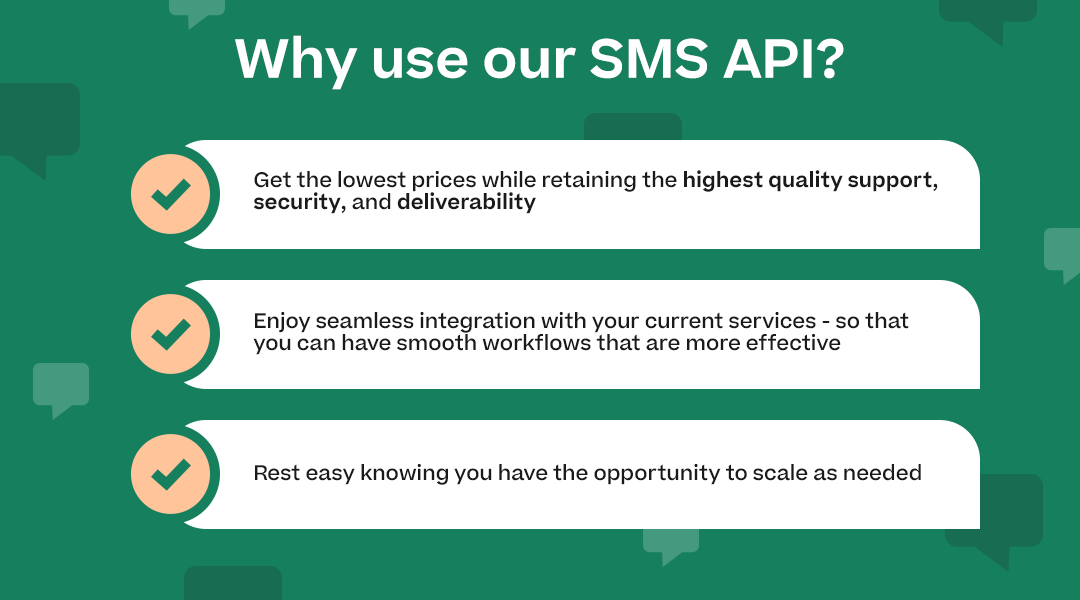
These are some of the features you’ll get with the Mobile Text Alerts API:
- Developer-friendly API: RESTful API with clear documentation, key authentication, and support for easy integration.
- Global reach & coverage: Send messages to people all over the world.
- Transparent pricing: Enjoy pricing that flexes to your needs and scales as you do, as low as $.0039 per message.
- Strong documentation: Solid API documentation that allows developers to implement without a lot of hassle.
- Compliance: Legal and carrier compliance by managing opt-in and opt-out processes automatically.
- Dedicated support via Slack: Get live developer support via a dedicated Slack channel for enterprise customers.
- MCP servers: Take advantage of MCP servers that make integrating SMS easier than ever.
- SMPP server: Connect via SMPP for SMS messaging from systems that use the SMPP protocol.
- Two-way messaging: Manage direct conversations with customers through the platform or API.
- Mass iMessage: Send bulk iMessages to reach users beyond SMS.
- White glove setup and migration: Enjoy the white glove treatment as your team gets all the attention and help they need to move forward with setup and migration.
- Contact segmentation: Categorize contacts for targeted messaging via API.
- Message templates: Store templates to reuse common texts without rewriting code every time.
- Language-agnostic: Accepts standard GET/REST requests (works with Ruby, PHP, Python, Java, C#, or any modern stack; SDKs optional).
Why Businesses Need a Programmable SMS API in 2026
It’s easy to think of a programmable SMS API as just another integration until you’re staring at a backlog of messages that didn’t fire, a support inbox filled with password-reset complaints, or a spreadsheet of leads that should have been followed up on days ago.
Two things are non-negotiables in 2026: speed and visibility. A programmable SMS API gives you both.
Here are the benefits that make it indispensable:
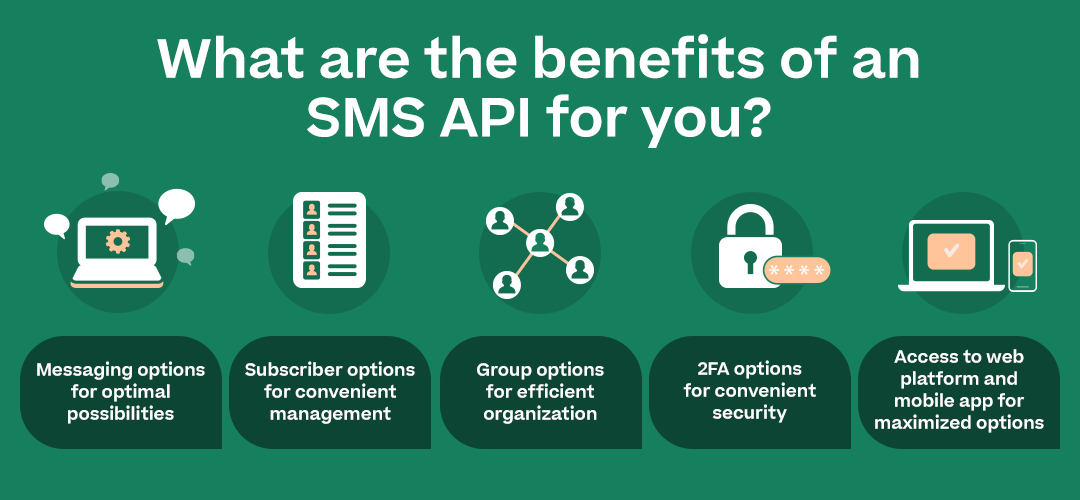
Messaging options that scale with your goals
With a programmable SMS API, your team can fire off texts globally in seconds, triggered automatically by the events that matter: a new signup, a status change, or a purchase confirmation.
And when you need more than 160 characters, MMS lets you stretch to 1,550 and add images, GIFs, or flyers, so you can say more when the message calls for it without third party tools.
Most importantly, replies don’t vanish into thin air. Every response routes back through our SMS API, which means you can manage true 2-way conversations programmatically.
Mobile Text Alerts supports sending to up to 190+ countries, with routes through 10DLC, toll-free, and short code numbers depending on your volume and use case.
Subscriber management that saves you time
Clean data is everything.
A programmable SMS API gives you precise control of your subscriber list, so every message goes to the right person at the right time.
With it, you can:
- Add or remove contacts via the SMS gateway API at any time.
- Pull a complete database view when you need the big picture.
- View individual subscriber info (phone number, opt-in status, group membership) through the “Get Subscriber” call
Better put, your contact data stays accurate, current, and ready for action without manual work.
Group options for efficient organization
What’s worse than digging through a messy sock drawer, hoping to find a matching pair?
Sorting through an unorganized spreadsheet of contacts on a Monday morning. Even worse, all manually.
A programmable SMS API lets you create and segment subscribers into groups — for example, “VIP customers,” “trial users,” or “event attendees” — so you can tailor campaigns with precision.
And because it’s automated, the process scales alongside your business effortlessly.
Built-in security with 2FA
Have you ever scrambled to reset a password, only to get stuck waiting for a code that never arrives? Very few things are as frustrating — and for your customers, it’s a quick way to lose trust.
Two-factor authentication (2FA) via SMS fixes that by sending a one-time code straight to a user’s phone. And with a programmable SMS API handling the process, those codes are both secure and instant.
The API generates the code, delivers it within seconds, and verifies the login automatically, so your users get peace of mind and your dev team isn’t wasting time manually resetting accounts or answering login complaints.
Access to web platform and mobile app for maximized options
Sometimes you need code-level control. Other times, you just need to log in and send a message right now. The best SMS API providers give you both.
Alongside the SMS API and developer tools, you get a full web platform and mobile app.
Need to schedule a campaign, check delivery reports, or blast out an urgent alert? You can do it in a dashboard with a few clicks — no code required.
This flexibility matters in 2026, when teams need speed as much as scalability. With Mobile Text Alerts, you can integrate the programmable SMS API into your CRM and still manage campaigns from a clean web interface on your laptop or an app on your phone.
What Can You Do With a Text Message API? (Use Cases)
There are quite a number of things you can do with our SMS API and they go way beyond just “sending texts.”
Some of the most valuable use cases include:
Triggered texts that drive engagement
With our SMS API, your team can send texts the moment a customer takes action on your site or app. Purchase completed? Send a receipt instantly. Cart abandoned? Trigger a gentle nudge. Form filled? Follow up before the lead goes cold.
Example: “Thanks for your order! Your receipt is here: [link].”
These triggered flows keep customers engaged without manual follow-up and helps your team capture revenue that would otherwise slip away.
CRM syncing that saves you hours
Our text message service API can sync your CRM with your SMS contact list automatically.
Whenever a new lead is added to your CRM, they’re also added to your team’s SMS list and sent a welcome text without anyone lifting a finger.
Example: “Welcome to the PieChart family! You’ll receive SMS notifications for office emergencies or closures.”
This automation eliminates duplicate data entry, prevents data drifts, and keeps subscriber records current without anyone exporting or importing spreadsheets.
Automated reminders and alerts that reduce no-shows
SMS is unbeatable for time-sensitive messages.
With our SMS text API, your team can automate reminders, alerts, and account notifications so customers get the right details at the right time.
This means fewer missed appointments, fewer “where’s my order?” tickets, and fewer late-night support calls — saving your comms team stress and giving developers fewer manual triggers to manage.
Example: “Your appointment is tomorrow at 10am. Reply C to confirm.”
Two-factor authentication that builds trust
Security is non-negotiable in 2026. Our text message API makes it simple to send automated 2FA codes, so users can verify accounts instantly.
Think about the alternatives: email-based codes that land in spam folders, or authenticator apps your customers forget to install. Both create friction. Our programmable SMS API removes that friction by putting verification on the one device people always check: their phone.
Marketing blasts that scale
Finally, the bread-and-butter: campaigns. With Mobile Text Alerts’ mass messaging feature, your team can schedule a flash sale promo to thousands of subscribers at once — with segmentation, time-zone sensitivity, scheduling, and rich media baked in.
Example: “Exclusive deal for VIP customers: 20% off this weekend only. Tap here to claim your discount [link].”
For comms leaders running frequent promotions or developers tasked with building repeatable systems, this balance of speed, certainty, and personalization is what turns a list into a responsive audience.
Send SMS (Without Wasting Engineering Hours)
In 2026, the best SMS API providers share three essentials: scalability, reliability, and transparent pricing. Miss any one of those, and you’ll pay for it later in wasted engineering hours, failed campaigns, or customer trust lost.
Check out the Mobile Text Alerts developer docs for yourself.
API Providers: Frequently Asked Questions
What is an SMS API?
Which SMS API is best?
How to set up an SMS API?
What is an SMS gateway API?
Is this SMS API secure?
Does this SMS API work for international messaging?
How long does it take to set up the Mobile Text Alerts SMS API?
Editor Bio

Sam Pelton is the content director for Mobile Text Alerts, an SMS service that gives businesses an easier way to reach customers and audiences. He has 12 years of experience working with the texting platform in the areas of customer support, quality assurance testing, content creation, copywriting, and marketing strategy. The delivery and cost figures in this article come from his analysis. He’s also a father of 6 and loves a good (bad) dad joke. Connect with him on LinkedIn.