


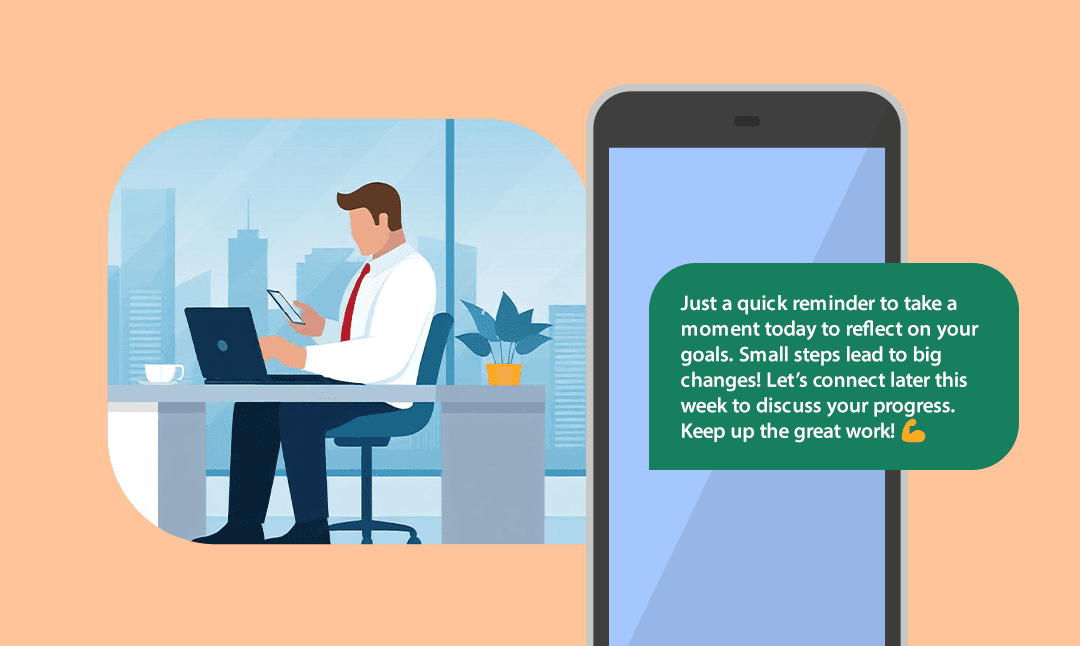
You’re a business mentor. You’ve got a coaching session scheduled.
You send a reminder, block time, prep for the session…but your client doesn’t show up.
It’s not that they’re uncommitted, they probably just missed your email!
That’s one reason why more business mentors should turn to SMS. It lands exactly where your clients are looking: their phones.
With read rates as high as 55% and near-instant visibility, SMS is hard to miss.
The global coaching industry is valued at $103.56 billion in 2025 and is expected to grow to $161.10 billion by 2030, with a steady CAGR of 9.24%.
That means more clients to reach, more follow-ups to manage, and less time to do it manually.
SMS marketing for business mentors keeps things simple: clients are more likely to show up because they won’t miss your reminder. You don’t have to chase them!
Despite being around for over 30 years, SMS is still the easiest way to connect with people. So why not make the most of it for your business mentorship services?
Here’s your step-by-step guide to send SMS for business mentors, plus strategies and best practices for reaching and retaining clients via SMS.
Step-by-Step Guide to Send SMS for Business Mentors: TL;DR
This guide walks you through:
- Why SMS outperforms email and app notifications for visibility and engagement
- 5 high-impact SMS marketing strategies for business mentors: personalization, automation, micro-touchpoints, omnichannel coordination, and choosing the right tool
- Best practices to keep messages short and effective
- How to track SMS campaign performance with real-time analytics
- Privacy and compliance essentials like opt-in/opt-out and encryption
- Emerging trends like AI-driven messaging, RCS, and SMS-based group business mentorship programs
Is SMS Really Better than Email or Apps to Reach Business Mentorship Clients?
Email is great for sending recaps or resources, but it’s easy to miss, especially when your client’s inbox looks like a war zone.
App notifications only work if your client’s using the app, has notifications turned on, and happens to be looking at their screen at the right time.
SMS doesn’t wait around for ideal conditions; it delivers your message instantly without friction. Whether your client’s using the latest iPhone or a five-year-old Android, the message gets through and gets seen.
That’s why SMS is still the most reliable channel for time-sensitive communication.
Text message marketing is not here to replace email or apps but to do what these channels can’t: guarantee visibility when it counts.
Let’s see how SMS stacks up against other channels in real business mentorship scenarios:
| Feature | SMS | App Notifications | |
|---|---|---|---|
| Requires internet | No | Yes | Yes |
| Requires app | No | No | Yes |
| Delivery speed | Immediate | Immediate | Immediate |
| Read likelihood | Very high | Moderate | Low to moderate |
| Friction | Medium | Medium | High (downloads, permissions) |
| Best for | Reaching everyone quickly | Long-form updates | In-app engagement |
5 Steps/Strategies to Reach Business Mentorship Clients via SMS Campaigns
SMS marketing for business mentors works best when it feels like a real conversation. Here are 5 strategies to help you stay on track:
Step 1: Choose the Right SMS Marketing Tool
As your client list grows, the easiest way to stay consistent and intentional with your messaging is to use a platform that supports how you work.
That’s where Mobile Text Alerts fits in. It’s ideal for business mentors and consultants who want to automate outreach and market themselves without losing the human feel.
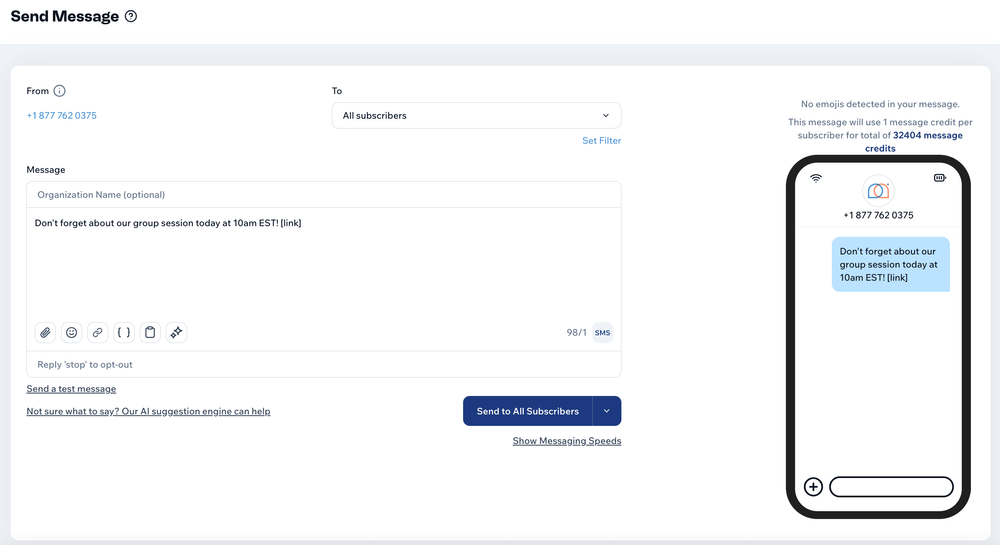
Here’s how you can use Mobile Text Alerts for SMS automation for business mentors:
- Send one message to your entire list or specific segments and engage in two-way conversations
- Let clients opt in via QR codes, text-to-join keywords, forms, or manual import. Segment by program, goal, or engagement level to personalize your SMS outreach for business mentor clients
- Set up recurring texts, post-session follow-ups, or full drip campaigns. You define the timing and triggers, Mobile Text Alerts handles the rest
- Use SmartSMS AI tools to draft, shorten, or improve your texts in seconds. Save time while keeping your message on brand
- Manage SMS campaigns on-the-go using the business texting app
Ready to make SMS your most consistent and scalable client touchpoint?
Start your free trial with Mobile Text Alerts and see how effortless personalized outreach can be!
Step 2: Use Automation and AI to Create (and Scale) Your SMS Campaigns
Your SMS tool will allow you to set up automated campaigns, and will even allow you to use AI to refine your content.
As your client base grows, staying personal at scale becomes a challenge.
You want every client to feel seen, but you can’t spend your entire day sending the same reminder ten or a hundred or a thousand different ways.
That’s where automation and AI help you do more with less.
SMS automation lets you schedule, trigger, and send texts based on client actions or timelines.
It could be a session reminder, a post-call follow-up, an upsell opportunity, or a check-in for someone who’s gone quiet. You can set it up once and let it run in the background.
AI adds the smart layer. It can suggest the best time to send messages and personalize content based on behavior.
Instead of drafting every text manually, you have to simply approve and fine-tune.
As a result, you can keep your clients engaged consistently and expect fewer no-shows.
Here's what an automated flow might look like:
- Session booked -> Instant confirmation
- 1 day before -> Reminder with time and location/link
- Day of session -> Short encouragement to show up energized
- 1 day after -> Follow-up with next steps or a feedback prompt
Step 3: Make Every Message Personal
As you are building your campaigns per step 2 above, make sure your messages are personalized.
Your clients expect communication that feels personal, not something pulled from a template.
Personalization in SMS means tailoring each message to reflect your client’s goals, past sessions, progress, or specific roadblocks.
A few examples of personalized SMS messages for business mentors:
- “Hey Tim, great work hitting your three-week goal. Ready for the next one?”
- “Just a quick reminder, your 1:1 session is tomorrow at 2 PM. Let’s build on last week’s momentum!”
- “You mentioned you were struggling with focus. Want to try that 5-minute meditation before your next call?”
Let your messages reflect that you're paying attention.
The more context you include, the more your client feels seen, and the more likely they are to stay engaged.
Step 4: Stay Connected Between Sessions with Micro-Touchpoints
In addition to creating campaigns to promote your individual sessions, you’ll also want to build campaigns that help you stay connected to clients between sessions.
You don’t always need long emails or perfectly worded updates to keep clients engaged.
Sometimes, short and well-timed messages are all you need to show you’re still in their corner.
Micro-touchpoints are quick, focused interactions that keep momentum going between sessions.
Examples:
- “We’re halfway through the month—want to revisit the goal we set?”
- “Session’s tomorrow at 10. Don’t forget to bring the notes from last week!”
- “You nailed it on Monday. Let’s keep that energy up.”
Use micro-touchpoints to:
- Recognize milestones and celebrate effort
- Reconnect with clients who’ve slipped off routine
- Strengthen commitment to goals
- Check in without making it formal
Over time, these quick messages do more than keep people on schedule.
They build trust and accountability, and at the same time, make clients feel genuinely supported even when you’re not on a call.
Step 5: Analyze Campaigns and Iterate
Continuously evaluating your campaigns using the analytics tools within your SMS service will give you the insight you need to iterate on and optimize your campaigns.
See the "How to Measure" section below for more on analyzing SMS campaigns.
Undefined Step: Integrate SMS with Omnichannel Outreach Strategies
All throughout the process, you’ll want to be integrating your SMS into your omnichannel outresch strategies in deeper ways.
Omnichannel outreach means creating a unified experience across platforms.
You’re building a journey where each touchpoint reinforces the next, and SMS plays a key role in making sure nothing gets missed.
Here’s how it fits in:
- Before the inbox: Use SMS to give a heads-up before a longer email lands
- After the group chat: Wrap up WhatsApp or in-app discussions with a clear, actionable SMS summary
- When attention drops off: Follow up on unread emails with a quick, friendly nudge via text
The goal is to bring urgency to your client comms without overwhelming them.
To make this work, your systems need to talk to each other.
Look for platforms that integrate with your CRM and automation tools, so you can trigger messages based on behavior and update client records automatically.
Also read: How to send an SMS campaign to sell a coaching package
Best Practices for Effective SMS Outreach in Business Mentorship
If you're using SMS to keep clients engaged, timing and clarity matter just as much as content.
Here are some best practices you should follow while running your SMS outreach campaigns:
Start with pacing
Sending 1-2 texts per week is enough to maintain steady engagement without overwhelming your clients.
One message might be a session reminder, the other could be a motivational nudge or a follow-up after a win.
If you’re texting more than that, it should be by request or part of a time-bound program.
Keep it short
Stick to 160 characters or fewer. One message should have one purpose.
Don’t try to confirm, coach, motivate, and ask for feedback all at once. Say the most important point and leave it there.
Test and refine
Pay attention to what gets replies and what doesn’t.
Try different send times or adjust the tone.
If your messages start getting ignored (or worse, lead to opt-outs), it’s probably time to change cadence or content.
Simple A/B testing can give you enough insight to course-correct.
Respect the channel
Always get an opt-in before sending texts and make it easy to opt out.
Avoid sending anything after hours unless the client has said it’s okay. And if they respond, a quick and thoughtful reply goes a long way.
| ✅ Do | ❌ Don’t |
|---|---|
| Get clear opt-in before texting | Send messages without permission |
| Keep messages short and focused | Cram multiple asks into one text |
| Personalize with context when it adds value | Over-message to the point of fatigue |
| Include an opt-out in automated flows | Use SMS for long updates or sensitive topics |
| Reply promptly when clients text back | Ignore drop-off or disengagement signals |
Also read: Marketing for Coaches: 1 Thing No One's Talking About (+15 Tips)
How to Measure the Impact of SMS Marketing for Business Mentors?
Real-time SMS analytics gives you immediate feedback on how clients are interacting with your messages.
You can track delivery, response, engagement, and opt-outs, all in one place.
Use the data to refine your tone, timing and frequency to match what your audience actually responds to.
Key SMS metrics to watch out for
| Metric | What it tells you |
|---|---|
| Delivery rate | Shows how many messages successfully reach clients. If delivery is low, check for invalid numbers or carrier filtering. |
| Reply rate | A key coaching metric. High reply rates suggest your messages are clear, timely, and relevant. |
| Opt-out rate | Spikes here are warning signs. Frequent unsubscribes often mean your cadence is too aggressive/frequent or off-topic. |
| Click-through rate (CTR) | Tracks engagement with links (like worksheets, forms, or session bookings). Low CTR signals unclear CTAs or poor timing. |
By tracking what works (and what doesn’t), you can:
- Adjust send times based on actual engagement
- Improve response by testing tone or format
- Catch message fatigue before it leads to drop-off
- Increase retention by matching your outreach to each client’s behavior
_With an SMS marketing tool like Mobile Text Alerts, you get access to built-in SMS analytics. _
You can track link clicks to see which calls‑to‑action gain traction, review sent message reports for delivery success, monitor subscriber trends to understand list growth or stagnation, and examine opt‑out data to spot when messaging may be off‑track.
Once you have the numbers, you’ll have more clarity on how to make the SMS campaign more impactful.
- High reply rate indicates you’re getting the tone and timing right. Keep that rhythm and continue using what clearly resonates with your clients.
- Low click rate signifies your call to action may be too long or buried. Simplify it and move it higher in the message.
- High opt-outs mean you’re texting too frequently or not offering enough value. Slow the cadence and focus on content that helps or motivates.
- Drop in replies is usually a sign of fatigue or poor timing. Experiment with different send times or reduce message volume to re-engage attention.
Design a Privacy-First SMS Strategy Clients Can Trust
Clients trust you with their goals, their time, and their personal information.
To maintain that trust, make privacy and compliance a core part of your SMS strategy.
SMS compliance means following the legal, ethical, and privacy standards that govern permission-based texting.
That includes global regulations like GDPR and CCPA, which require you to:
- Get explicit opt-in consent before sending texts
- Provide clear, easy opt-out options in every automated message
- Respect data rights like access, deletion, and correction
To keep outreach aligned with client expectations, here’s what every business mentor should take care of:
SMS compliance checklist for business mentors
| Requirement | Why it matters | How to implement it |
|---|---|---|
| ✅ Opt-in consent | Required by law; builds trust | Use forms, checkboxes, or double opt-in |
| ✅ Easy opt-out | Keeps you compliant and client-friendly | Add “Reply STOP to unsubscribe” to messages |
| ✅ Privacy policy access | Transparency is important | Link to your policy in your onboarding flow |
| ✅ End-to-end encryption | Protects client data during transmission | Choose tools that offer encryption by default |
| ✅ Record of consent | Proves compliance in case of audit | Keep timestamps of opt-in confirmations |
A few quick reminders:
- Never scrape or purchase client phone numbers
- Avoid sending sensitive financial or personal info via SMS
- Always double-check integrations (CRMs, automations) for compliance settings
- Tell clients why you’re messaging and how they can control it
Future Outlook: Evolving SMS Trends Impacting Business Mentors in 2026
SMS for business mentors is entering a new phase; one that’s more personal and increasingly automated.
AI is taking on a larger role, helping business mentors send the right message at the right time without extra effort. Expect to see deeper personalization, predictive insights, and AI-driven recommendations that adapt to each client’s journey.
We’re also seeing the rise of conversational AI and Rich Communication Services (RCS) that turn basic text exchanges into richer, more interactive experiences. Think image sharing or embedded booking links within a single chat thread.
As the industry matures, subscription-based business mentorship and group programs delivered via SMS may become more common.
For business mentors, the takeaway is clear: the way we use SMS as a mode of communication will keep evolving, and so will client expectations.
The sooner you adapt to smarter, more interactive communication, the easier it becomes to scale your business without losing the personal touch that makes it work.
Use Mobile Text Alerts to deliver smarter, more personalized messages that meet clients where they are and keep them coming back.
Start your free trial today (no credit card needed)!
Frequently Asked Questions
What are the top SMS outreach trends for business mentors in 2026?
AI-driven personalization, smarter segmentation, and seamless integration with channels like WhatsApp and web chat are leading the way. These trends are helping business mentors boost engagement and automate more of their workflow, while delivering a more consistent client experience.
How can business mentors use AI to improve their SMS communication?
AI helps business mentors personalize messages based on each client’s behavior, automate reminders and follow-ups, analyze which texts get responses, and make your outreach more timely and effective.
What tactics can improve engagement and conversions in SMS campaigns?
Start with smart segmentation. Tailor your messages by client type or journey stage. Keep content dynamic and interactive, and align SMS with other touchpoints like email or social media to stay consistent without overwhelming your clients.
How do business mentors integrate SMS with other communication channels?
Many are creating an omnichannel setup where SMS, email, WhatsApp, and web chat work together. The goal is to reach clients on the right channel at the right time, without doubling up or sending mixed messages.
What privacy and compliance best practices should business mentors follow?
Always get clear consent before texting. Offer easy opt-outs. Use encrypted platforms and be upfront about how client data is used. These practices help you build long-term trust with your clients.
Author Bio:
Rodoshi Das is a B2B SaaS content marketer. With a strategist’s mindset and a researcher’s curiosity, she crafts product-led content that strengthens brand visibility across SERPs and LLMs and drives measurable results. When she isn’t brainstorming new content ideas or testing tools, she’s usually lost in a book, rewatching The Office for the hundredth time, or planning her next mountain getaway.