


Explore this content with AI:
You know that moment when something breaks in the business or even in your daily life and your stomach drops?
A system failure, a security breach, a canceled class, a last-minute venue change—whatever it is, someone needs to know now.
As someone who’s sat in that seat more than once, I can tell you the channel you choose in that moment determines whether the situation stabilizes or spirals.
But here’s the question...
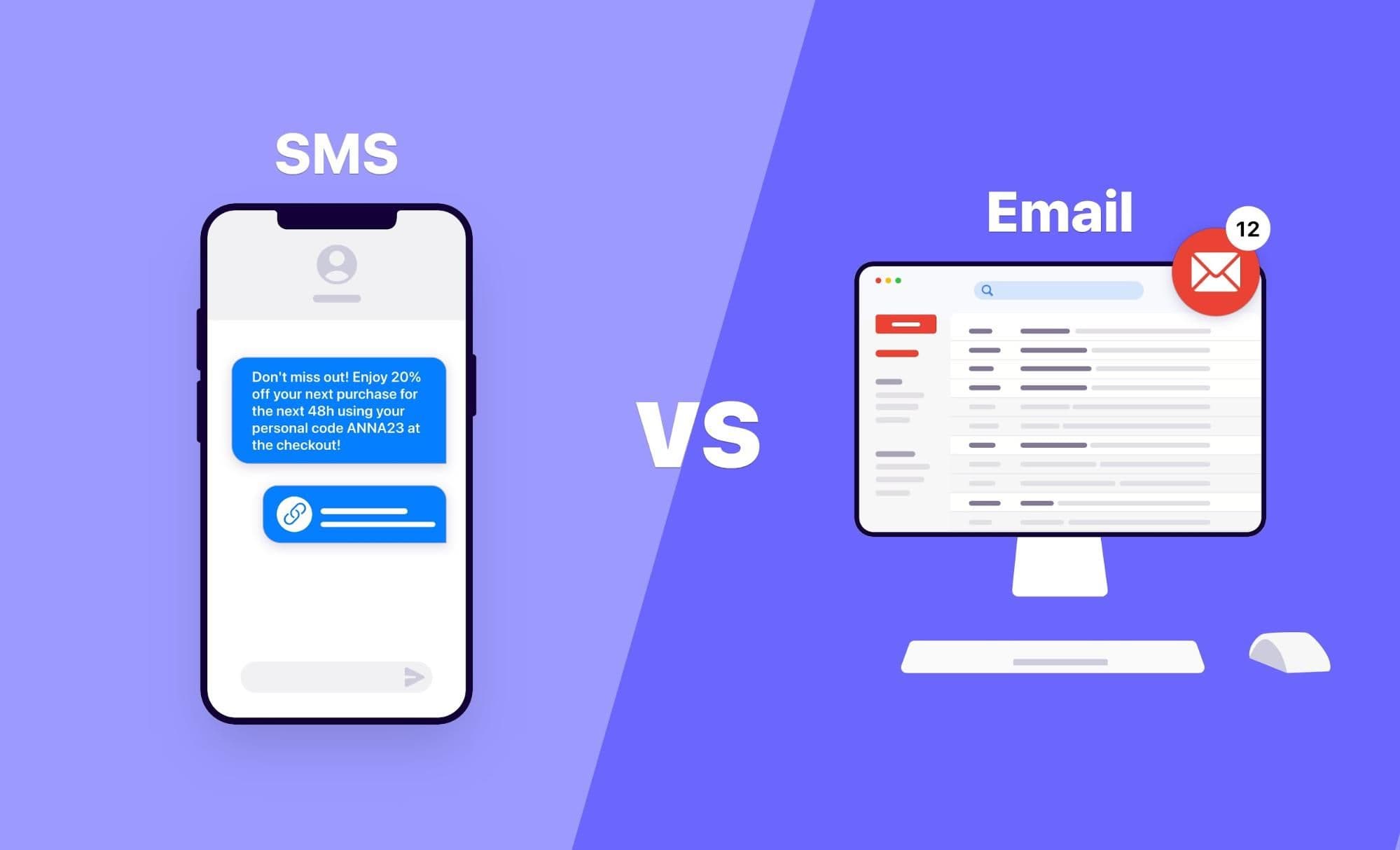
In what situations is email better than SMS for urgent updates, and vice versa?
People spend hours upon hours on their phone daily. Many look at their lock screen within seconds of receiving a notification.
Email on the other hand takes a while to be seen because very few refresh their inbox on instinct. That’s why we’re comparing text alerts and email through a single lens: urgency.
Let’s get into the real differences, grounded in data, shaped by experience, and informed by what we’ve seen across thousands of businesses using Mobile Text Alerts for critical communication.
Framework: In what situations is email better than SMS for urgent updates, and vice versa?
The differences between SMS and email do not mean that one replaces the other. They serve complementary purposes when used intentionally.
A simple framework helps teams choose correctly.
- If the message requires attention within one or two hours, use SMS.
- If the recipient faces consequences for missing the update, use SMS.
- If the message contains detailed explanations, use email.
- If the message needs to be searchable later, use email.
- If the information is both urgent and complex, use both.
- And in general, it doesn’t hurt to use both!
The important part is not the channel itself. It is the order. Urgent information belongs at the front. Supporting information belongs behind it.
Side-by-side comparison of why SMS is generally better than email for urgent updates
In general, SMS is better than email for time-sensitive messages.
Here’s a side-by-side summary of why:
| Metric | Text Alerts (SMS) | |
|---|---|---|
| Open Rate | Approximately 55% “open rate“ and 100% “view rate.“ Messages appear on the lock screen and are usually seen without deliberate checking. | Approximately 35.9%. |
| Time to Awareness | Quick awareness. | Awareness depends on inbox-checking habits. Delays of several hours are common. |
| Click-Through Rate | High. | Low. |
| Deliverability Risk | Low as long as compliance guidelines are followed. | Vulnerable to spam filters, promotions tabs, throttling and inbox overload. |
| Message Format | Brief messages. | Unlimited length allows detailed information, attachments and multiple links. |
| Cost Structure | Subscription tiers or per-message fee. | Subscription tiers based on list size or volume. Marginal cost per additional send is low. |
| Best Use Case | Time sensitive alerts where visibility, speed and action are essential. | Detailed updates, context, documentation and non-urgent communication. |
However, all of that being noted, email certainly still has its place. It can give more detailed information for more complicated updates, and can be a good backup in case SMS fails (and vice-versa - SMS can be a good backup in case email fails).
The key elements that makes SMS better than email for urgent updates
At a glance, for differences between text alerts and email for urgent updates, we have:
- Urgent communication behavioral patterns
- Visibility
- Awareness speed
- Engagement
- Message clarity
- Economic consideration
- Reliability under stress
1. Why urgent communication behaves differently from everyday messaging
One reason why SMS is better than email for urgent messages is communication behavioral patterns.
Before comparing SMS and email, it helps to start with the nature of urgent communication itself. Urgent communication has three defining qualities.
- It must reach people quickly.
- It must be understood immediately.
- It must drive action without hesitation.
Ordinary communication tolerates delay.
A marketing email can be opened tomorrow. A policy update can be read next week. A newsletter can remain unopened without consequence.
Urgent communication cannot absorb this flexibility. If a customer must know about a contaminated product, or an employee needs to avoid a dangerous area of a facility, or a student must be informed that classes are canceled before leaving home, time becomes the central variable.
This shift in stakes reveals a gap between the channels.
Email is designed for depth and flexibility rather than speed. It relies on a pull mechanism. The recipient needs to actively check their inbox to notice anything.
Text alerts use a push mechanism. They interrupt the user with a notification that appears instantly on the lock screen.
The behavioral difference between these two mechanisms influences every metric that follows.
Understanding this foundation is important because it shows why the remaining differences are not random.
2. Visibility
A second reason why SMS is better than email for time-sensitive messages is visibility.
If people never notice the message, none of the other metrics matter.
SMS has an average open rate of about 55%, but a view rate of 100%.
People read text messages because the notification appears directly on a device that they check reflexively throughout the day. The lock screen preview does half the work. Even if the recipient intends to ignore the message, their brain still registers it.
Email visibility on the other hand looks very different. A recent study suggested average open rates (in the UK at least) are 35.9%.
Why such a gap?
You need to take in consideration that some people receive hundreds of emails each day, others disable notifications to avoid distraction and many ignore inboxes outside work hours. Also, we have to deal with spam filters and secondary tabs.
If the goal is awareness, SMS has a structural advantage that cannot be replicated by formatting or subject-line tricks.
Mobile Text Alerts takes advantage of this natural visibility pattern by helping businesses like yours deliver messages that immediately trigger device notifications.
3. Awareness speed
Another reason why SMS is better than email for time-sensitive messages is awareness speed.
Visibility and awareness are quite related but not the same. Visibility measures whether the message is seen while awareness measures how quickly recipients process after seeing.
Researchers who study communication latency often refer to the concept of time-to-awareness as the interval between a message being delivered and the moment the recipient becomes mentally aware that new information has arrived. In urgent situations, this interval matters as much as delivery itself.
Text messages can reach awareness within seconds because many people check their phones the moment the screen lights up.
(You can track your SMS engagement with our advanced analytics by signing up for a 14 day free trial here.)
Let’s bring that into email marketing. Do you read your emails minutes after they deliver to your phone? Unless you make an intentional effort to do so, the answer to this is obviously no.
To help paint the picture, if someone checks email once per day, the delay between delivery and awareness can be as long as 24 hours or even more.
During events where timing carries consequences, this difference can be very crucial, hence the use of SMS to compress time-to-awareness to its natural minimum.
4. Engagement
Yet another reason why SMS is better than email for urgent messages has to do with engagement.
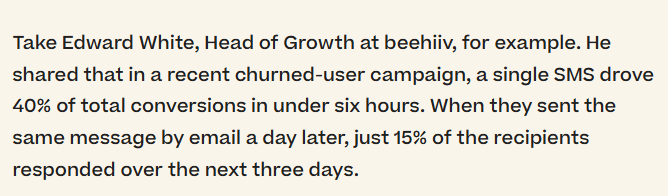
Urgent communication must prompt action—that is, engagement. Text alerts outperform email in engagement metrics because they meet people in a context where quick decisions feel natural.
SMS marketing benchmark snippets
The replies can come in within minutes because recipients seem more likely to treat texts as conversational rather than informational. As opposed to email’s lengthy and sometimes unclear copy, the conciseness of an SMS also clarifies the expected action (e.g., confirm attendance, click a link, or, reply with a number).
Why does SMS have better potential here over email? Likely because emails are rarely intimate or personal.
Yes, really good copy could move the needle. However, it seems we have associated emails so much with work and corporate lives that it creates a psychological distance from decision-making, thereby causing people to scan rather than act.
Click-through rates follow the same pattern. Text messages containing links produce click-through numbers between 19%-32% according to one report, while email click-through rates average between 2.09%-3.25% (granted, these email click-throughs are not taking into account that some emails are not pushing for a click, so the comparison isn‘t totally one-to-one, but the numbers are still staggering).
Teams using SMS services such as Mobile Text Alerts see the practical results of this difference in real time.
5. Message clarity
A fifth reason why SMS is better than email for time-sensitive messages is related to message clarity.
The format of each channel influences how people interpret the message.
SMS limits each segment to roughly one hundred and sixty characters (although more can be used if you‘re willing to use extra message credits).
Rather than viewing this as a constraint, teams may find that the limit improves communication under pressure. Urgent updates benefit from a focused instruction. The recipient should immediately know what the message implies and/or requires.
Email, however, offers unlimited space. This seems helpful until organizations attempt to use it for time-sensitive updates. Customers have to deal with long paragraphs, disclaimers, multiple links, and contextual explanations that dilute the core message. The recipient now needs to extract the urgent instruction from the rest of the content which can create friction in moments of urgency.
This is why many organizations pair both channels. The SMS delivers the essential instruction. The email carries follow-up materials, attachments, or background. Mobile Text Alerts supports this approach by allowing teams to send concise alerts while linking to more detailed pages when needed.
The result is a communication structure where the recipient receives the most important information first. Everything else is optional.
6. Economic considerations
One tricky element when considering whether SMS is better than email for urgent messages is the economic consideration.
SMS carries a higher per-message cost than email, which means teams feel the price of every alert they send. With email, the incremental cost of sending one additional email is nearly invisible. This creates an economic contrast, but it does not change the calculation that matters in time-sensitive communication.
In urgent communication, the cost of failure is far higher than the cost of messaging. A missed appointment can cost hundreds of dollars in revenue. A delayed safety update can result in equipment downtime or injury. A customer who fails to notice a recall notice may suffer real harm. A staff member who does not see a schedule update can destabilize an entire shift.
When organizations weigh the cost of messaging against the cost of inaction, SMS becomes the far more economical choice.
Mobile Text Alerts reinforces this cost structure by offering a free trial that covers all messaging fees. This allows organizations to test urgent scenarios without financial risk. The moment they see how quickly messages reach people and how consistently recipients respond, the economic advantage becomes self-evident.
7. Reliability under stress
One final reason reason why SMS is more effective than email for time-sensitive messages is greater reliability under stress.
Email deliverability is more fragile than many organizations realize:
- Spam filters sometimes flag legitimate terms that sound too forceful.
- Promotions tabs absorb messages unintentionally.
- Server throttling during high-traffic periods delays deliveries.
- In some cases, the inbox itself is full and cannot receive new emails.
The sender rarely receives warnings when these issues occur. A report may show the message as delivered even if it never reached the primary inbox.
With SMS, carrier filtering exists, but legitimate businesses that verify their sender identity and follow compliance guidelines will experience low block rates. Messages reach devices directly and are displayed immediately.
This reliability is the reason why some hospitals, transportation systems, universities, and government agencies rely heavily on text alerts during emergencies when they need to send time-sensitive updates.
(But note: for the best reliability, it is ideal to use both channels.)
If you want a communication system that responds as quickly as your business does, Mobile Text Alerts offers a simple and dependable way to reach people in the moments that matter. Once you experience how quickly people respond to text alerts, I bet you wouldn’t switch back to using emails...
Urgent information belongs in SMS (with perhaps a corresponding backup email to go along with it). Everything else can follow.
Sign up for a 14 day free trial on Mobile Text Alerts.
FAQ
Is SMS or email faster for urgent updates?
SMS often reaches awareness within minutes. Email reaches awareness whenever the recipient checks the inbox.
Is SMS more reliable during emergencies?
Yes. SMS is more likely to be seen quickly by recipients.
Can SMS confirm delivery?
Yes. Platforms like Mobile Text Alerts provide delivery receipts for verification.
Does SMS limit message length?
Yes and no. Standard SMS messages contain approximately one hundred and sixty characters per segment, although you can include more at greater credit cost. Email has no meaningful limit.
Should teams combine SMS and email?
Yes. Use SMS for immediacy and email for detail. Together they create a more complete communication flow.