



If you’ve ever looked at your SMS marketing invoice and wondered, “Where did these extra line items come from?”—you’re not alone.
Those tiny ‘carrier surcharge’ (pass-through fee) line items? They’re like loose change in your couch—until you dump the jar and realize it’s hundreds (or thousands!) of dollars a month. If you’re planning SMS campaigns for 2026, you’ll need to know exactly how to budget for them.
This guide breaks down everything: what carrier surcharges are, how they’re structured, how much carrier pass-through fees cost per message, and how to keep your SMS budget under control, all while maintaining excellent deliverability.
TL;DR
- Carrier surcharges are pass-through network fees charged by carriers (like AT&T or T-Mobile) on every SMS or MMS.
- 10DLC is best for local business texting, toll-free for nationwide reach, and short codes for high-volume campaigns.
- Verified 10DLC and toll-free traffic unlock lower pass-through fees and prevent content filtering or blocking.
- Use the formula (Messages × [Base Rate + Carrier Pass-Through Fee]) + program and number fees to forecast your true SMS spend.
- Keep messages under 160 characters, stay compliant, and choose a transparent provider like Mobile Text Alerts that shows real pass-through costs.
What Are Carrier Pass-Through Fees?
When you send a text message through an SMS marketing platform, that message doesn’t travel directly from your laptop to your customer’s phone. It passes through a chain of systems:
You (the sender) → Your SMS platform (e.g., Mobile Text Alerts) → SMS aggregator → Telecom carriers (AT&T, Verizon, T-Mobile, etc.) → Recipient’s phone
Each telecom carrier charges a small per-message fee for using their network to deliver your texts. These are carrier surcharges, also known as** carrier pass-through fees**.
Carriers added these fees to filter spam, maintain network infrastructure, manage the growing volume of commercial texts, and maintain their profitability.
📍Note: Carrier pass-through fees are separate from your platform’s subscription cost and the base price per message your SMS provider charges.
How Much Are SMS Carrier Pass-Through Fees per Message? (Snapshot as of November 2025)
Here are sample pass-through fees (registered vs. unregistered) from major U.S. carriers:
| Carrier | Channel | Registered SMS (Outbound USD) | Unregistered SMS (Outbound USD) | Registered MMS (Outbound USD) | Unregistered MMS (Outbound USD) |
|---|---|---|---|---|---|
| AT&T | 10DLC | $0.0030 | $0.0100 | $0.0075 | $0.0150 |
| T-Mobile, Metro, Sprint | 10DLC | $0.0030 | $0.0120 | $0.0100 | $0.0210 |
| Verizon | 10DLC | $0.0040 | $0.0100 | $0.0065 | $0.0065 |
| US Cellular | 10DLC | $0.0050 | - | $0.0100 | - |
| TextNow | 10DLC | $0.0020 | - | $0.0020 | - |
How Much Are SMS Carrier Pass-Through Fees per Message for Canada 10DLC & Toll‑Free?
Canadian carriers structure pass-through fees similarly, but with some quirks:
- Fees are in CAD, often a bit higher per message than U.S. equivalents.
- Some U.S-based platforms bill Canadian messages in USD using an FX conversion; you’ll want to verify how your platform handles currency.
- Fewer carriers = fewer number type options; toll-free verification can differ.
Sample rates (amount in CAD):
| Carrier | Outbound SMS (Mobile Terminated) | Outbound MMS (Mobile Terminated) | Inbound SMS (Mobile Originated) | Inbound MMS (Mobile Originated) |
|---|---|---|---|---|
| Bell & Virgin | $0.011 | $0.021 | $0.000 | $0.000 |
| Rogers & Fido | $0.010–$0.011 | $0.020–$0.022 | $0.000 | $0.000 |
| Telus | $0.008–$0.0133 | $0.013–$0.0265 | $0.000 | $0.000 |
| Freedom Mobile | $0.006–$0.009 | $0.012 | $0.000 | $0.000 |
Pro tip: If your business spans the U.S. and Canada, track your messaging volumes by country. Canadian messages may cost more, and the FX conversion may erode margin if billed in USD.
How SMS Billing Actually Stacks, Taking into Account How Much SMS Carrier Pass-Through Fees Are per Message
Your $0.01 per SMS is just the sticker price.
The out-the-door price includes carrier tolls, registration, and a little math. Here’s what all goes into the honest total.
| Layer | What it means | Example Rate |
|---|---|---|
| Base Message Cost | What you pay your SMS provider for “sending” the message—routing, platform, API, dashboard. | ~$0.010 |
| Carrier Pass-Through Fees | What the mobile carrier charges for delivering the message. Pass-through cost. | ~$0.003–$0.010 (varies) |
| Platform/Number/Registration Fees | Setup costs, number leasing, registration (10DLC), program fees. Also provider margin. | Varies |
Suppose you send 100,000 messages in a month using a registered 10DLC number:
- Base cost: 100,000 × $0.010 = $1,000
- Carrier pass-through fee (avg $0.004): 100,000 × $0.004 = $400
- Registration + number fees (say $15/month + $4 one-time amortized): ~$20
By adding all these costs, you spend $1,420 for that campaign.
By understanding the real cost of your campaign, you can stay compliant with carrier rules and optimize campaigns for highest returns on every message.
The Three Phone Number Types That Shape Your Cost
Another key variable that influences your SMS marketing budget is the type of phone number you’re sending from.
Each number type—10DLC, Toll-Free, or Short Code—comes with its own carrier rules, pass-through fees, and throughput limits and can swing your total campaign cost by hundreds or even thousands of dollars.
10DLC (10-Digit Long Code)
A 10DLC is a 10-digit phone number you can use for your business that looks like a “regular” 10-digit phone number with a geographical area code.
It’s perfect for everyday use—appointment reminders, customer notifications, or quick two-way conversations. Because these numbers look like regular local phone numbers, people tend to trust and reply to them more.
But there’s a catch: 10DLC numbers must be registered through The Campaign Registry (TCR). That process adds a few small fees—around $4 for brand registration and about $10 per campaign per month.
Once registered, you unlock lower carrier pass-through fees (about $0.003–$0.004 per message).
Toll-Free Numbers (TFN)
Toll-free numbers are those classic 10-digit numbers with an 800-style “area code” as the initial digits and work well if your audience spans the U.S. or Canada. Carrier pass-through fees average around $0.0025 per SMS—a little cheaper than 10DLC.
MMS (like product images or shipment photos) messages cost more, usually $0.015 each. While throughput is slower than short codes, toll-free numbers hit the sweet spot between cost efficiency and credibility for most medium-scale brands.
Short Codes
Short codes are 5 or 6-digit numbers built for high-volume, time-sensitive SMS campaigns. If you’re sending hundreds of thousands or millions of messages, short codes deliver speed (hundreds per second) and reliability.
Such high performance of short codes, however, comes at a high price too. The setup fee is typically around $650 and monthly leases near $995, plus per-message carrier pass-through fees of roughly $0.0018.
Speed and deliverability of short codes outweigh the upfront cost for big retail campaigns, but often are an overkill for small vendors.
| Number Type | Best for | Setup Cost | Pass-Through Fee Range | Registration Needed |
|---|---|---|---|---|
| 10DLC | Everyday business texting | Low | $0.002–$0.015 | Yes |
| Toll-Free | Support / alerts | Low | ~$0.0025 | Yes (verification) |
| Short Code | High-volume marketing | High | $0.001–$0.005 | Yes |
The Sneaky 30–40% SMS Costs (And How to Predict Them in Light of How Much Carrier Pass-Through Fees Are per Message)
If you only budget for your per-message rate—say, $0.01 × 250,000 messages = $2,500—you’re missing key cost layers that can add 30–40% to your actual invoice.
For instance:
- Carrier pass-through fees: $0.004 × 250,000 = $1,000
- Registration/campaign fee: $15/month
- Message length (avg. 1.2 segments due to longer messages, emojis, or special characters): +20% volume
Your real monthly cost jumps from $2,500 to roughly $4,015 ($2,500 + $1,000 + $500 [extra segments] + $15)—a big difference if you’re running recurring campaigns.
Below is a table of additional fees and “hidden” costs that you should account for in your campaign’s budget.
| Fee Type | What it Means | Typical Cost |
|---|---|---|
| Brand registration (U.S. 10DLC) | Registers your business with The Campaign Registry | $4 one-time |
| Campaign registration (10DLC) | Approves your specific messaging use case | $10–$15/month |
| Toll-free verification | Confirms number's legitimacy with carriers | Usually free (but can take time) |
| Short code setup & lease | Dedicated number for high-volume messaging | $650 setup + $995/month average |
| Number leasing / maintenance | Carrier or platform charges for number upkeep | $15–$30/month |
| Multipart/segment penalty | Messages exceed 160 characters or include special characters/emoji | Variable (often doubles cost) |
| Compliance/penalty risk | Violating carrier or campaign rules | $250–$10,000+ |
Now that you know what drives your total cost, here’s a quick way to calculate your monthly SMS spend:
Total SMS Cost = (Messages × [Base Rate + Carrier Pass-Through Fees]) + Program Fees + Number Fees + Segment/Encoding Multiplier
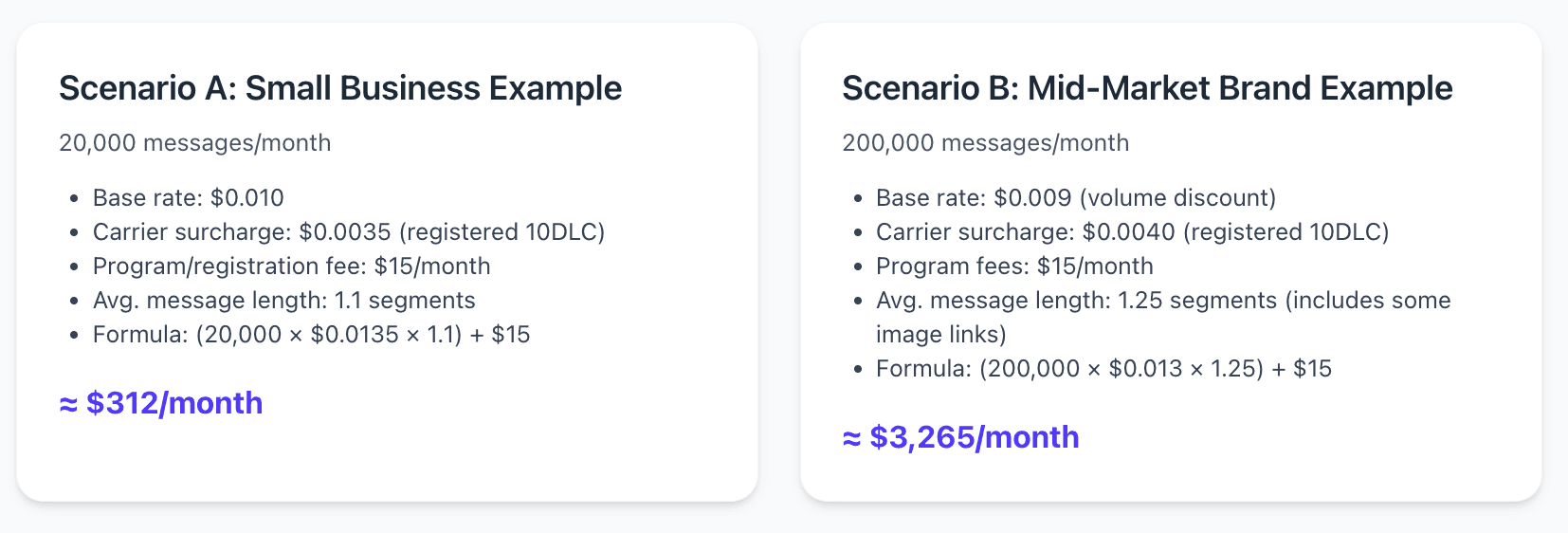
Scenario A: Small Business Example
- Volume: 20,000 messages/month
- Base rate: $0.010
- Carrier pass-through fee: $0.0035 (registered 10DLC)
- Program/registration fee: $15/month
- Avg. message length: 1.1 segments
Cost: (20,000 × $0.0135 × 1.1) + $15 ≈ $297 + $15 = ~$312/month
Scenario B: Mid-Market Brand Example
- Volume: 200,000 messages/month
- Base rate: $0.009 (volume discount)
- Carrier pass-through fee: $0.0040 (registered 10DLC)
- Program fees: $15/month
- Avg. message length: 1.25 segments (includes some image links)
Cost: (200,000 × $0.013 × 1.25) + $15 = $3,250 + $15 = ~$3,265/month
Common SMS Penalties and Fees to Avoid
Carriers like T-Mobile and AT&T actively enforce compliance standards, and if your campaigns don’t follow the rules, the fines can sting.
The good news is that these penalties are entirely avoidable.
Pass-Through Fines
Most “fines” in SMS marketing aren’t imposed by your messaging platform. They’re pass-through penalties from the carriers themselves. That means if a carrier flags your campaign for non-compliance, the cost can land on your bill.
Below are some violations that you might want to keep in mind.
| Violation Type | Typical Fine (USD) | What Triggers It |
|---|---|---|
| Program Evasion | $1,000 | Sending messages from an unregistered number or using an unapproved campaign |
| Content Violation | $10,000 | Sending restricted or misleading content or omitting required opt-out language |
| Number-Pool Misconfiguration | $2,000 | Using too many phone numbers per campaign or failing to associate numbers properly in the registration system |
| Non-Use Fee | $250 | Registering a campaign and then leaving it inactive for too long. |
| NNID Misuse | Variable | Sending traffic through the wrong network identifier |
Check with your SMS provider to see how they handle these types of fees.
Mobile Text Alerts has measures in place to prevent these fees from incurring and thus generally does not pass these types of fees onto customers.
Unregistered or Filtered Traffic
Unregistered 10DLC traffic doesn’t just come with higher pass-through fees—it also faces a serious risk of being filtered or silently dropped. Carriers now use automated filtering to detect and stop “gray-route” messages, so unregistered traffic may never reach its destination.
If you’re running an ongoing campaign, that can mean paying for thousands of undelivered messages—and missing your customers entirely.
Mobile Text Alerts helps you avoid these pitfalls by automatically aligning with carrier guidelines. Our platform makes it simple to:
- Register your 10DLC campaigns correctly and keep them active.
- Monitor message health so you can catch delivery issues early.
- Stay compliant with opt-in, opt-out, and content best practices baked into every workflow.
How to Reduce SMS Cost (Without Hurting Engagement)
You don’t have to sacrifice quality or compliance to control spend. A few small adjustments can make a big difference:
✅ Register your 10DLC or verify your toll-free numbers: Registered traffic always gets better deliverability and lower carrier pass-through fees.
✅ Keep messages under 160 characters: Avoid special characters or emojis unless they’re absolutely essential as they can trigger multi-segment billing.
✅ Use MMS strategically: Rich media can drive engagement but costs more. Split-test before scaling image-based sends.
✅ Use high-quality routing: Mobile Text Alerts connects directly with carrier-approved routes, ensuring stable delivery and consistent pricing—no “mystery markups.”
✅ Clean your list regularly: Remove invalid, landline, or VOIP numbers. Every failed attempt still counts toward your bill.
✅ Respect opt-outs automatically: Mobile Text Alerts handles unsubscribe requests seamlessly to prevent compliance penalties and reduce wasted sends.
✅ Match your volume to your number type: 10DLC, toll-free, and short code each have different throughput and cost trade-offs. Our platform helps you pick the right balance for your scale and use case.
International and Cross-Border Considerations
If you send outside the U.S./Canada, the following are the key considerations:
- Each country has its own pass-through fee matrix and number-type rules; some have much higher pass-through fees.
- Many U.S. platforms bill everything in USD and apply an FX conversion; this can eat margin if CAD rises.
- Throughput, regulatory rules (opt-in/out) and number-type availability differ widely; you could face delays or higher cost.
Pro tip: If you operate in the U.S. and Canada, set separate budgets. CAD pass-through fees are often higher and USD billing + FX can dent margin.
Make Every Message Count
Carrier pass-through fees aren’t random add-ons—they’re the cost of accessing a trusted, regulated network. When you understand how these fees work, you can turn SMS from a “black box” expense into a predictable, high-ROI channel.
Mobile Text Alerts gives you full visibility into every layer of your messaging costs—so you always know where your money is going, how to optimize delivery, and how to stay compliant while scaling.
Start your free 14-day trial today to see exactly how transparent SMS budgeting can simplify your marketing operations.
FAQs
Why is MMS more expensive?
MMS uses more data, may require media transcoding, and often triggers larger segments — carriers reflect that in higher pass-through fees.
Can I avoid carrier pass-through fees entirely?
Not really. They are network-level fees. What you can avoid is inflated vendor markups, unregistered number pass-through fees, and paying for segments you didn’t need.
My “per message” rate is fixed at $0.01—why is my bill higher?
Because that likely reflects your base rate only. The actual cost also includes carrier pass-through fees, number fees, registration, and possibly multi-segment charges.
How do I decide between 10DLC vs toll-free vs short code?
It depends on volume, send frequency, campaign type (notification vs promotion), cost sensitivity, and throughput. Use the examples above to model each.