


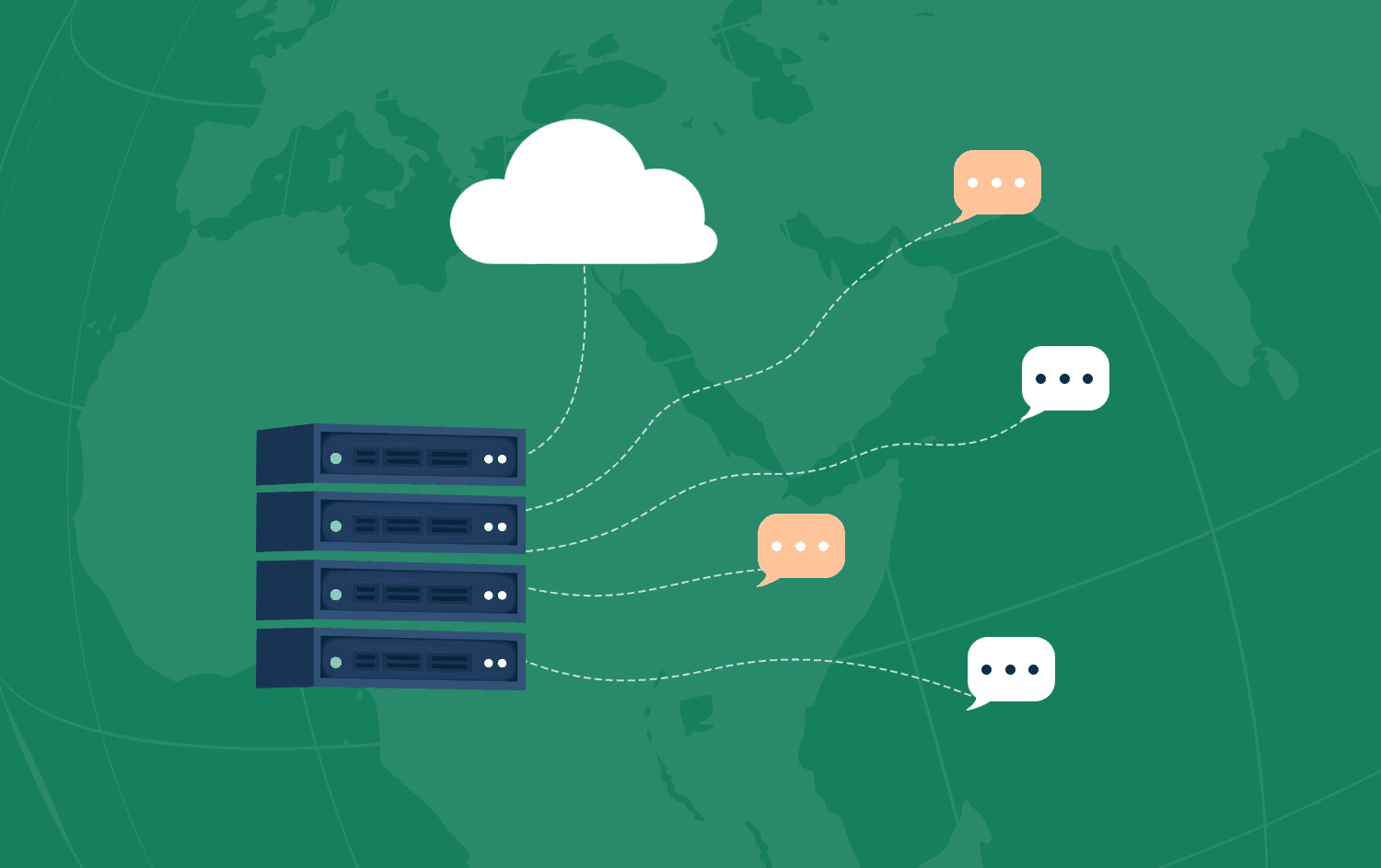
When you’re only sending a few hundred texts a day, almost any SMS provider will do. But many businesses don’t live in that world.
Sometimes your teams are running OTPs that must hit within seconds. You’re pushing time-sensitive offers to thousands of customers at once. You’re coordinating operations where a delivery delay means lost revenue or reputational damage.
And here’s another catch: sometimes you need an SMS API that supports scheduled sends, because you need to reach people at specific times.
(For example, appointment reminders or event notices.)
In this guide, we’ll break down the 6 best high-throughput SMS APIs that support scheduled sends, evaluated for:
- Throughput capacity (messages per second/minute/hour)
- Delivery reliability (carrier routes, redundancy, latency)
- Compliance readiness (TCPA, GDPR, 10DLC, regional rules)
- Integration and API performance (how easily they sync with your CRM/ERP/workflows)
- Enterprise-grade support and scalability
Can You Give Me a List of SMS APIs that Support Scheduled Sends?
If you want the shortlist without scrolling, here’s how the top providers stack up. Mobile Text Alerts comes first for a reason: it balances raw sending power with the kind of reliability and usability enterprises actually need.
| Provider | Best For | Why It Matters at Scale | Pricing (2025)* |
|---|---|---|---|
| Mobile Text Alerts | Enterprises needing scale + simplicity | Global reach, developer-friendly API, transparent pricing, strong documentation, compliance | Custom, as low as $.0039/SMS |
| Twilio | Developer-led global rollouts | API-first, massive coverage, enterprise-grade reliability; costs climb at scale, throughput varies by carrier region | From $0.0083/SMS |
| Sinch | Security/compliance-heavy industries | Global data centers, GDPR/HIPAA support, trusted by large enterprises; less transparent pricing | From $0.0035/SMS |
| Telnyx | SMS + IoT use cases | Full-stack communications with SMS, IoT SIMs, and low-latency APIs; throughput is strong, but add-ons increase costs | From $0.0045–$0.0075/SMS |
| Bird (MessageBird) | Multichannel enterprises | 240+ carrier connections, omnichannel messaging, advanced analytics; pricing and support lack transparency | From $0.0075/SMS |
| Infobip | Global enterprises at extreme volume | Direct-to-MNO routing, omnichannel suite, 258B+ SMS sent in 2024; contracts are complex and costly | Custom pricing |
*Pricing as of 2025. May vary by volume, region, and throughput commitments.
How to Choose the Right SMS API for Scheduled Sends
An SMS API for scheduled sends must keep delivery reliable across regions and stay compliant with carrier rules. When evaluating providers, check for:
| What to Check | Why It Matters |
|---|---|
| Throughput Capacity (MPS) | Enterprise gateways should support hundreds of messages per second without throttling. Some vendors cap throughput by trust score (e.g., A2P 10DLC in the U.S.), which can delay alerts and OTPs. |
| Direct Carrier Routing | Gateways with direct-to-carrier routes and automatic failover deliver messages faster and with fewer drops compared to providers using grey routes. |
| Latency Guarantees | Look at latency percentiles, not just averages. A good benchmark is sub-0.5s delivery even during peak loads; higher spikes can disrupt authentication flows or urgent notifications. |
| Regulatory Compliance | At scale, you must pass carrier filtering and local regulations (TCPA, GDPR, DND). A gateway that ignores compliance risks results in your traffic being blocked. |
| Monitoring & Reporting | Real-time dashboards with error codes and delivery status help enterprises detect issues early. Without visibility, failed messages can go unnoticed until customers complain. |
| Protocol & Integration | Support for SMPP 3.4 with connection pooling is critical for high throughput. REST APIs, CRM, and marketing stack integrations make daily operations easier. |
| Uptime & SLA | Look for a 99.99% SLA with multi-region redundancy. Anything less risks outages during traffic spikes or carrier downtime. |
| Transparent Pricing | Enterprise SMS costs can hide surcharges for international routing or premium routes. Always evaluate the total cost of ownership, not just headline per-SMS rates. |
Mobile Text Alerts (Best Overall for High-Throughput Enterprise Messaging)
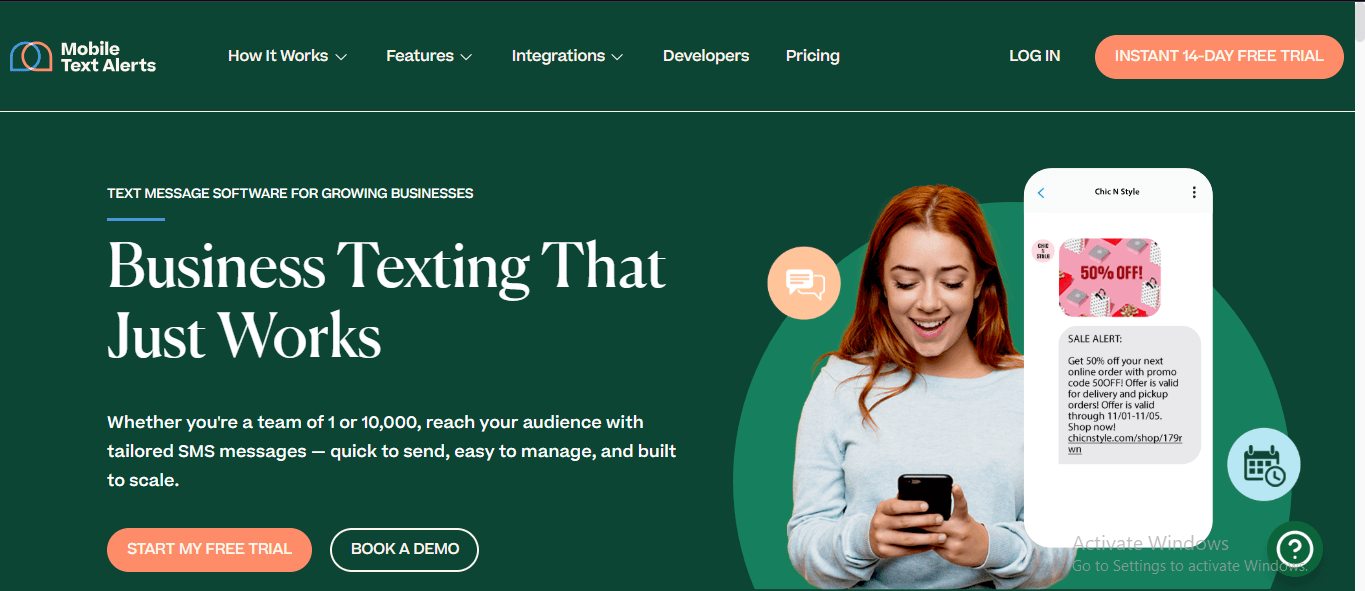
Mobile Text Alerts: Enterprise texting made simple—compliant, scalable, and supported by real people.
Mobile Text Alerts is purpose-built for enterprises that need reliable, large-scale SMS delivery without sacrificing compliance or support. Unlike providers that lean on bots and generic FAQs, Mobile Text Alerts offers direct human assistance—a critical advantage when your campaigns involve millions of messages or regulated communications.
Its platform combines throughput capacity, carrier redundancy, and compliance-first design, making it a strong fit for finance, healthcare, retail, and other industries where failed delivery is not an option.
Standout Features
- Send & Receive SMS via Developer-Friendly API: Send and receive tens of thousands of SMS per second with developer-friendly, API-driven throughput for enterprise traffic.
- Global Reach & Coverage: Send messages to people all over the world.
- Transparent Pricing: Enjoy pricing that flexes to your needs and scales as you do, as low as $.0039 per message.
- Strong Documentation: Solid API documentation that allows developers to implement without a lot of hassle.
- Dedicated Support via Slack: Get live developer support via a dedicated Slack channel for enterprise customers.
- MCP Servers: Take advantage of MCP servers that make integrating SMS easier than ever.
- Two-Way Messaging: Connect with your audience 1-on-1 and receive their responses so your team can continue to engage.
- Clear Verification Timelines and Deliverability Benchmarks: Get clarity with verification and deliverability expectations so you can have confidence that your messages are getting seen.
- White Glove Setup and Migration: Enjoy the white glove treatment as your team gets all the attention and help they need to move forward with setup and migration.
- Reliable Delivery at Scale: Use carrier redundancy and optimized routing to prevent throttling, delays, or dropped messages during peak campaigns.
- Automated Scheduling & Real-Time Tracking: Access delivery receipts, error codes, and engagement metrics instantly to spot failures before they cascade.
- Security & Compliance: Enforce TCPA, 10DLC, and carrier rules with automated opt-in/opt-out management and audit-ready logs.
- Integration with Enterprise Systems: Connect SMS into CRMs, ERPs, and automation tools through RESTful APIs and webhooks.
- iMessage Support: Send via iMessage where SMS faces restrictions or international gaps.
Also Read: 2025 SMS Marketing Benchmarks with Insights from 15 Experts
What Users Say About Mobile Text Alerts
Pros
- Provides real human support to resolve issues faster compared to chatbot-heavy competitors.
- Offers transparent pricing with no hidden carrier surcharges, helping enterprises manage large-scale budgets.
- Delivers strong compliance features that minimize risks of carrier filtering or TCPA violations.
- Scales seamlessly with no limits on users or contacts, supporting enterprises as messaging volume grows.
Cons
- Uses custom, volume-based pricing, which means enterprises must engage with sales, but it ensures tailored rates at scale rather than one-size-fits-all plans.
Pricing
Mobile Text Alerts has pricing options as low as $.0039 per message.
It offers a 14-day free trial so enterprises can validate throughput and compliance before committing. After the trial, pricing moves to custom, volume-based plans with discounted rates for high-scale messaging.
Twilio (Best for Developer-Centric Enterprises and Global Scale)
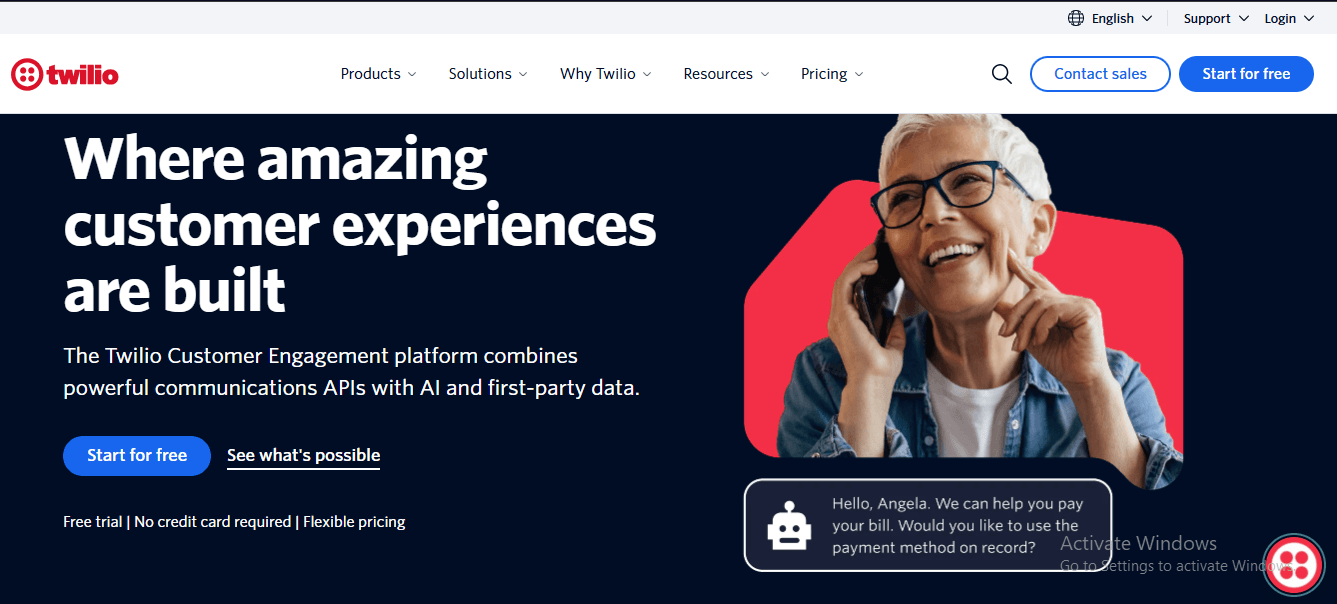
Twilio: Helps enterprises send at scale with flexible APIs, but setup and costs can weigh heavy.
Twilio is a top choice for enterprises that need a developer-first, highly customizable SMS gateway capable of handling massive volumes worldwide. It’s built for organizations with complex communication needs, offering SMS, MMS, WhatsApp, voice, and email APIs under one programmable platform.
Standout Features
- Scale Messaging Globally: Send SMS, MMS, and multi-channel messages at enterprise volume with Twilio’s programmable APIs.
- Choose Number Types: Use short codes, long codes, or toll-free numbers to match brand identity and compliance requirements.
- Automate Two-Way Communication: Enable interactive messaging, automated responses, and AI-driven conversations with customers.
- Optimize Delivery: Rely on Twilio’s delivery intelligence for routing, queuing, and error handling across carriers worldwide.
- Track Campaign Performance: Access real-time analytics, including delivery insights, heatmaps, and engagement metrics.
- Integrate with Any Tech Stack: Use SDKs, webhooks, and multi-language developer libraries for faster deployment.
- Expand Beyond SMS: Leverage support for WhatsApp, email, RCS, and voice to run true omnichannel campaigns.
What Users Say About Twilio
Pros
- Provides unmatched scalability and global carrier reach.
- Offers developer-first tools and documentation for seamless integration.
- Delivers rich analytics that inform campaign optimization.
- Supports true omnichannel communication beyond SMS.
Cons
- Charges add up quickly, especially for international routes or high-frequency campaigns.
- Support often leans on automation, and many enterprise users report delays reaching a live agent.
- Setup can be complex, making it less friendly for non-technical teams.
Pricing
Pay-as-you-go pricing starts at $0.0083 per US SMS segment, with additional costs for premium routes, short codes, and international messaging. Enterprise plans include volume discounts, but many reviewers note that costs rise steeply without them.
Sinch (Best for Global Omnichannel and Built-in Verification)
Sinch: Powers mobile-first experiences with scalable, omnichannel messaging for global enterprises.
Sinch is a Communications Platform as a Service (CPaaS) heavyweight built for enterprises that need worldwide reach, verification, and strict compliance. It’s widely used in finance, healthcare, and retail, where messaging must scale across multiple countries while meeting local regulatory standards. Beyond SMS, Sinch also supports WhatsApp, RCS, and other channels from a single platform.
Standout Features
- Global SMS API: Provides direct/operator-grade routing and two-way messaging (where supported) to improve deliverability across regions.
- High Throughput & Scalability: Supports large bursts via batching, smart queuing, and provisioned capacity (SMPP, short code, 10DLC, toll-free).
- Omnichannel Messaging & Integration: Unifies SMS with WhatsApp and RCS; connects to CRMs/automation to run cross-channel workflows from one stack.
- Verification APIs: Delivers OTP and user authentication with channel fallback (SMS/voice/WhatsApp) to keep sign-ins and transactions moving.
- Compliance & Security: Enforces opt-in/opt-out and consent capture; aligns with TCPA/GDPR and supports audit-ready logging for regulated teams.
What Users Say About Sinch
Pros
- Strong marks for global reach and multi-channel support, making it easier to scale campaigns internationally.
- Developer-friendly APIs and SDKs that integrate well into CRM and automation systems.
Cons
- Pricing varies sharply by region, which complicates forecasting for global enterprises.
- UI and setup carry a learning curve, with reviewers noting initial friction.
- Support responsiveness is inconsistent, especially during high-impact incidents.
Pricing
Sinch uses pay-as-you-go SMS pricing with country-specific rates.
For example: U.S. 10DLC SMS at $0.0078 per message (send/receive), Poland outbound at $0.03555, inbound free. Numbers carry setup and monthly fees (e.g., Poland: $10 setup, $12.80/month).
Enterprise discounts and volume packages are available through sales.
Telnyx (Best for Network-Controlled Delivery and Cost Efficiency)
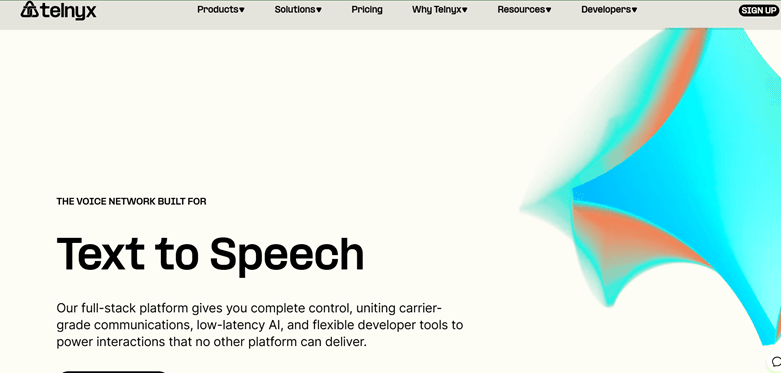
Telnyx: Delivers carrier-grade performance with flexible APIs, low latency, and AI-driven messaging.
Telnyx runs programmable messaging over its own private, global IP network—not just rented routes, so enterprises get lower latency, predictable delivery, and tight control as volumes climb. Its developer-first stack (APIs + Mission Control Portal) pairs transparent per-carrier fees with automatic volume discounts, which helps finance and ops teams keep total cost in check at scale.
Standout Features
- Global SMS API: Provides send/receive across local 10DLC, toll-free, and short code with two-way support where available, plus MMS in the U.S. and Canada.
- Private Global Network: Provides an owned, private, multi-cloud backbone designed for real-time communications, reducing hops, latency, and packet loss versus the public internet.
- Compliance & 10DLC Tooling: Provides guided registration and clearly documented carrier surcharges; blocks unregistered U.S. 10DLC traffic per 2025 rules to keep brands compliant.
- Developer Tooling & Observability: Provides REST APIs, webhooks, SDKs, and real-time delivery metrics in Mission Control for faster build-outs and production monitoring.
- Omnichannel Expansion: Provides WhatsApp/RCS options alongside SMS/MMS so teams can orchestrate cross-channel flows from one provider.
What Users Say About Telynx
Pros
- Low list pricing with automatic volume discounts; U.S. local/10DLC SMS starts at $0.004 per message part + carrier fees, with transparent surcharge tables by carrier.
- Private network control helps stabilize throughput during peaks and lowers latency for real-time messaging.
- Full number portfolio (local, toll-free, short code) and hosted SMS to bring existing numbers onto the platform.
Cons
- Developer-led onboarding and granular fee model can demand more in-house telecom know-how compared to a white-glove setup. (Inference from Telnyx’s self-serve posture and fee transparency.)
- Per-carrier surcharges add cost variability that finance teams must track when forecasting global campaigns.
Pricing
- Pay-as-you-go with automatic volume discounts.
- In the U.S., SMS starts at $0.004 per message part (plus carrier fees); MMS starts at $0.015 per part. Inbound SMS is $0.004 per part.
- Local and toll-free numbers start at $1/month, and dedicated short codes are $1,000/month (vanity: $2,000/month). 10DLC registration carries small brand/campaign fees.
Bird (MessageBird) (Best For Multi-Channel Enterprises)
Bird (MessageBird): Offers enterprise SMS reach with transparent pricing and global coverage.
Bird (formerly MessageBird) combines a global SMS API with native WhatsApp/email/voice under one platform. It’s built for teams that want SMS at scale plus marketing, support, and payments in the same stack, without stitching together multiple vendors.
Standout Features
- Global SMS API: Allows sending SMS to 150+ countries through a single, unified API—no extra markups, country tables available for live rates.
- High Throughput & Reliability: Runs on carrier-grade infrastructure with an uptime target backed by SLA, designed to keep large sends stable across regions.
- Omnichannel Messaging & Integration: Uses the same platform to launch WhatsApp campaigns (templates, buttons, catalogs), email, and two-way voice.
- Compliance & Controls: Provides built-in tools for subscription keywords, compliance keywords, frequency capping, and quiet hours to reduce filtering risk and keep programs audit-friendly.
- Developer Tooling & Automation: Provides docs, SDKs, and webhooks to support event-driven flows.
What Users Say About Bird
Pros
- Puts SMS, WhatsApp, email, and voice in one place—useful if your CRM workflows span channels.
- Practical compliance helpers (quiet hours, frequency caps) reduce manual policy work.
Cons
- Users report blocked/removed campaigns or account terminations and long approval cycles; credits sometimes lost.
- Reports of “buggy” behavior and weeks spent with support before mail/SMS worked, with deliverability issues (email), point to uneven reliability.
Pricing
Pay-as-you-go; per-message SMS pricing varies by destination and is shown in Bird’s country tables. Numbers are billed monthly. No additional markups are advertised; volume discounts and custom plans are available. Check the live pricing pages before budgeting.
Infobip (Best for Global Enterprises with Extreme Volumes)
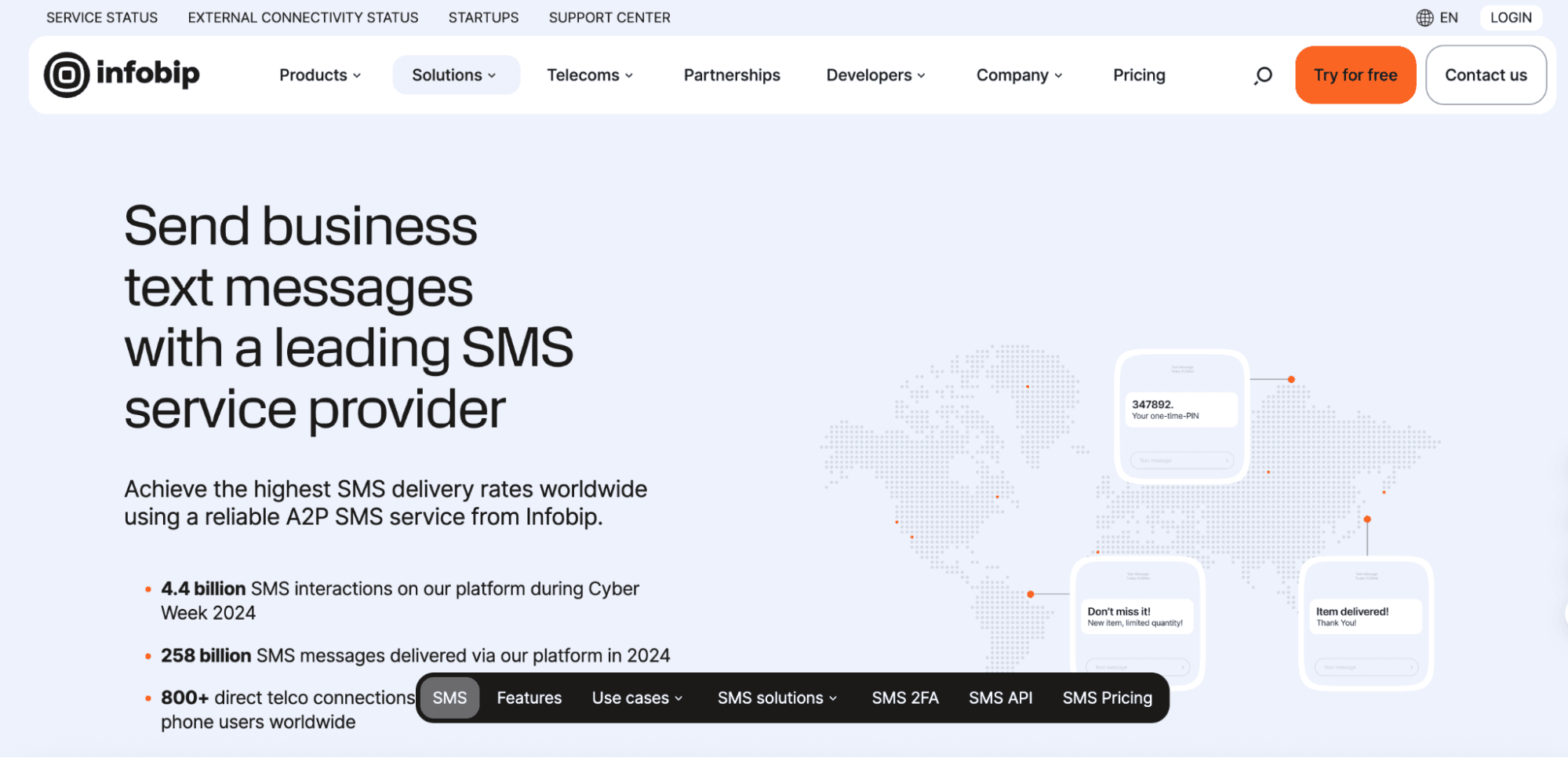
Infobip: Supports extreme-scale messaging with high delivery rates and 800+ direct carrier links.
Infobip is a major CPaaS platform trusted by banks, retail giants, and global ops teams. It combines SMS, RCS, WhatsApp, email, and voice in one fabric. It emphasizes smart routing, compliance, and integration with data tools so enterprises can orchestrate cross-channel flows under a single platform.
Standout Features
- Global SMS API: Provides local operator routing, fallback paths, and two-way SMS where supported—so you don’t need a different API per country.
- Message Personalization & Segmentation: Allows inserting user attributes into messages, plus dynamic segmentation for better targeting across campaigns.
- Automation & Scheduling: Supports defining workflows, scheduling sends, and trigger-based flows (e.g. birthday, follow-up).
- Two-Way Communication: Enables SMS replies in supported countries using Virtual Long Numbers or local numbers.
- OTP & Authentication Tools: Offers built-in support for 2FA and verified senders to protect against spoofing and fraud.
- Routing Intelligence: Chooses optimal path by cost, quality, and compliance rules across 9,700+ global network connections.
What Users Say About Infobip
Pros
- Provides omnichannel capabilities, blending SMS, WhatsApp, chat apps, email, and voice into one platform.
- Delivers reliable global reach with strong cross-border routing and compliance.
- Simplifies campaign setup with a clean, intuitive dashboard.
- Supports developer integration with well-documented APIs and CRM connectors.
- Tracks performance effectively with delivery receipts, scheduling, and campaign monitoring tools.
Cons
- Responds slowly to support requests, with users reporting delayed ticket handling.
- Creates confusion in failure reporting, offering limited clarity when messages fail or get delayed.
- Blocks accounts or deducts credits inconsistently at times, according to user feedback.
- Charges higher costs at some volume tiers or geographies compared to competitors.
Pricing
Infobip uses a pay-as-you-go model with volume discounts for big senders. The SMS rates depend heavily on the destination country, message length, and sender type (e.g., short code, 10DLC, local numbers). A public example: sending SMS to the U.S. may cost ~$0.0079 per message.
Narrowing the List Down to What Matters
When you strip away the marketing, here’s how these gateways stack up for enterprise CRMs:
- Twilio → Great developer flexibility, but expect steep learning curves and extra monitoring to manage costs at scale.
- Infobip → Strong omnichannel suites with automation, though contracts are complex, and support often feels enterprise-bureaucratic.
- Sinch → Reliable infrastructure and compliance, but pricing transparency and UI ease aren’t their strengths.
- Bird (MessageBird) → Useful for multichannel engagement, but less consistent on pricing clarity and support.
For businesses that want scheduled sends without trading off compliance, cost clarity, or human support, Mobile Text Alerts emerges as the practical choice. It maintains the enterprise-grade scale you’d expect while simplifying setup and providing access to real people when it matters.
However, before committing to long-term contracts or complex builds, test whether an SMS API actually meets your business’s scheduling needs.
Start a 14-day free trial with Mobile Text Alerts and validate performance on your terms.
FAQs
1: What is a high-throughput SMS API, and how is it different from a standard SMS API?
A high-throughput SMS API is built for enterprises sending millions of messages. Unlike standard gateways, which may cap throughput or rely on grey routes, high-throughput platforms use direct carrier connections, redundancy, and compliance checks to ensure large campaigns deliver quickly and reliably.
2: How do I choose the right SMS API for enterprise volumes?
Enterprises should look beyond pricing and check for:
- Proven throughput benchmarks (e.g., messages per second)
- Compliance safeguards (TCPA, GDPR, 10DLC, HIPAA, if applicable)
- Direct-to-carrier routing instead of grey routes
- Uptime guarantees and SLAs
- Integration readiness with CRMs and automation platforms
3: Which SMS gateway is the most reliable for global enterprise businesses?
Providers like Sinch and Infobip excel at global reach, but they can be complex and costly. Twilio balances scale with flexibility. Mobile Text Alerts is best for enterprises that want throughput and compliance without the overhead, offering human support alongside high-volume delivery.
4: Can I test an SMS API before committing to an enterprise contract?
Yes. Mobile Text Alerts offers a 14-day free trial so enterprises can test throughput, compliance features, and integrations before signing. Most global CPaaS providers also provide pay-as-you-go entry points, though advanced features often require enterprise contracts.
Author Bio
Nikita Rohira: Once an engineer, now a content marketer, Nikita Rohira blends curiosity with clarity. She spends her days shaping stories for B2C and B2B tech and her breaks listening as a certified counselor.
Telesign: Ensures global customer engagement with secure, scalable, and compliant SMS APIs.
Telesign blends SMS/MMS messaging with identity and fraud protection. Its messaging API uses over 700 direct routes, supports SMS in 230+ countries, and offers a fallback “waterfall routing” approach to improve deliverability. Its messaging API also supports omnichannel: SMS, MMS, email, WhatsApp, RCS, and Viber.
Standout Features
- Global Messaging API: Provides reach across 230+ countries, with fallback routing to alternative carriers or channels.
- High Throughput & Scalability: Supports large campaigns via direct routing and dynamic routing strategies.
- Omnichannel Messaging & Integration: Enables sending via SMS, MMS, RCS, WhatsApp, Viber, and email using one unified API.
- Compliance & Security: Offers built-in routing intelligence, fraud protection, and identity verification tools.
- Developer Tooling & Webhooks: Ships with clear docs, SDKs, and analytics for real-time insights.
What Users Say About Telesign
Pros
- Provides strong security and fraud features by combining messaging with identity and verification.
- Delivers broad global reach and fallback routing for message reliability.
- Offers flexible implementation: many users praise integration with fewer dependencies.
Cons
- Charges can add up: many users consider Telesign more expensive than comparable providers.
- Some report delays or slowness in verification workflows (OTP, MFA).
- Dependency on phone-based methods (SMS/voice) can falter in poor coverage or restricted regions.
Pricing
Telesign uses pay-as-you-go pricing, variable by destination. They list $0.0072 per message on their SMS & Voice page as a baseline. Volume discounts and tailored pricing apply for committed users. Some external sources estimate $0.01+ per message in the U.S. for certain tiers.
Narrowing the List Down to What Matters
When you strip away the marketing, here’s how these gateways stack up for enterprise CRMs:
- Twilio and Plivo → Great developer flexibility, but expect steep learning curves and extra monitoring to manage costs at scale.
- Vonage and Infobip → Strong omnichannel suites with automation, though contracts are complex, and support often feels enterprise-bureaucratic.
- Sinch and Bandwidth → Reliable infrastructure and compliance, but pricing transparency and UI ease aren’t their strengths.
- Bird (MessageBird) → Useful for multichannel engagement, but less consistent on pricing clarity and support.
For enterprise CRMs that want high-throughput SMS without trading off compliance, cost clarity, or human support, Mobile Text Alerts emerges as the practical choice. It maintains the enterprise-grade scale you’d expect while simplifying setup and providing access to real people when it matters.
However, before committing to long-term contracts or complex builds, test whether a high-throughput SMS gateway actually meets your CRM’s enterprise-volume needs.
Start a 14-day free trial with Mobile Text Alerts and validate performance on your terms.
FAQs
1: What is a high-throughput SMS gateway, and how is it different from a standard SMS gateway?
A high-throughput SMS gateway is built for enterprises sending millions of messages. Unlike standard gateways, which may cap throughput or rely on grey routes, high-throughput platforms use direct carrier connections, redundancy, and compliance checks to ensure large campaigns deliver quickly and reliably.
2: How do I choose the right SMS gateway for enterprise CRM volumes?
Enterprises should look beyond pricing and check for:
- Proven throughput benchmarks (e.g., messages per second)
- Compliance safeguards (TCPA, GDPR, 10DLC, HIPAA, if applicable)
- Direct-to-carrier routing instead of grey routes
- Uptime guarantees and SLAs
- Integration readiness with CRMs and automation platforms
3: Which SMS gateway is the most reliable for global enterprise CRMs?
Providers like Sinch, Infobip, and Vonage excel at global reach, but they can be complex and costly. Twilio and Plivo balance scale with flexibility. Mobile Text Alerts is best for enterprises that want throughput and compliance without the overhead, offering human support alongside high-volume delivery.
4: Can I test an SMS gateway before committing to an enterprise contract?
Yes. Mobile Text Alerts offers a 14-day free trial so enterprises can test throughput, compliance features, and integrations before signing. Most global CPaaS providers also provide pay-as-you-go entry points, though advanced features often require enterprise contracts.
Author Bio
Nikita Rohira: Once an engineer, now a content marketer, Nikita Rohira blends curiosity with clarity. She spends her days shaping stories for B2C and B2B tech and her breaks listening as a certified counselor.