



Explore this content with AI:
Twilio Verify is a widely used SMS 2FA API, but its model doesn’t scale cleanly for every team.
Pricing is tied to verification attempts rather than successful sign-ins, retry behavior is largely abstracted away, and deeper control over routing or verification logic often means moving outside the Verify layer.
As OTP verification volume grows, these tradeoffs turn SMS 2FA into a variable and harder to predict infrastructure cost.
To put the cost into concrete terms, consider a product that sends 500,000 OTPs per month. If even 15% of users trigger a second verification attempt because a code expires, a message arrives late, or the user refreshes the flow, that’s an additional 75,000 billable verification attempts.
You’re now paying for 575,000 attempts to support 500,000 sign-in events, even though nothing about your authentication security or conversion rate improved.
Multiply that across regions, channels, and peak traffic windows, and SMS verification becomes a function that costs an arm and a leg.
This article compares SMS 2FA API providers so you can choose a solution that keeps costs predictable and gives you the control you need as usage grows.
Below, we compare the top Twilio competitors for SMS 2FA APIs in 2026, focusing specifically on how each provider handles OTP verification, pricing mechanics, integration effort, and long-term scalability, so you can choose an option that stays predictable as your usage grows.
Top Twilio alternatives for SMS 2FA API: Quick comparison
Compare the leading Twilio alternatives for SMS 2FA APIs to find the right fit for your use case and budget:
| Provider | Best for: | |
|---|---|---|
Mobile Text Alerts | Verification-first SMS 2FA with predictable costs and straightforward integration | |
Vonage Verify API | Multi-channel verification (SMS, voice, email) with a mature Verify product | |
Telnyx Verify API | Teams that want more control over routing, pricing, and verification behavior | |
Plivo Verify API | Lightweight OTP verification without heavy abstractions via SMS + Voice | |
Bandwidth MFA API | Programmable MFA at scale using messaging and voice APIs. | |
Sinch Verification API | Global verification coverage with multiple fallback channels | |
Infobip 2FA | Enterprise-grade, omnichannel verification workflows | |
Bird Verify (MessageBird) | Guided verification flows with prebuilt tooling |
Top Twilio alternatives for SMS 2FA API
To keep this comparison practical, we focused on providers that offer a dedicated SMS 2FA or OTP verification API, not just generic SMS sending, and evaluated them on four criteria that have shown up in product discussions and buyer guides:
- Verification workflow completeness (OTP generation, delivery, validation, retries)
- Cost mechanics (attempt-based billing vs. clearer usage models)
- Control and flexibility (routing, retries, regional behavior)
- Integration effort (how quickly teams can ship and maintain the flow)
Below are the top Twilio alternatives that meet those standards today.
Mobile Text Alerts

Mobile Text Alerts is an SMS verification API that provides separate endpoints to create a one-time code, send it by SMS, and verify the user’s response, instead of requiring you to build OTP logic on top of a generic SMS send API.
Best for
Teams that want a purpose-built SMS verification API with a clear OTP workflow (generate → send → validate) rather than stitching verification together from generic messaging endpoints.
What you get (verification-specific)
- Provider-generated verification codes (OTPs)
- SMS delivery optimized for verification use cases
- Server-side validation of user-submitted codes
Key endpoints/workflow
Generate code → send SMS → validate submitted code (all supported by the verification service).
Pros
- Clear separation between verification logic and general messaging
- Easier to reason about OTP behavior, retries, and expiration
- No need to build or maintain custom OTP storage or validation logic
- Well suited for SMS-only verification at scale
Cons / limitations
- SMS-only (no WhatsApp/voice/email verification channels in this verification service documentation)
Vonage Verify API
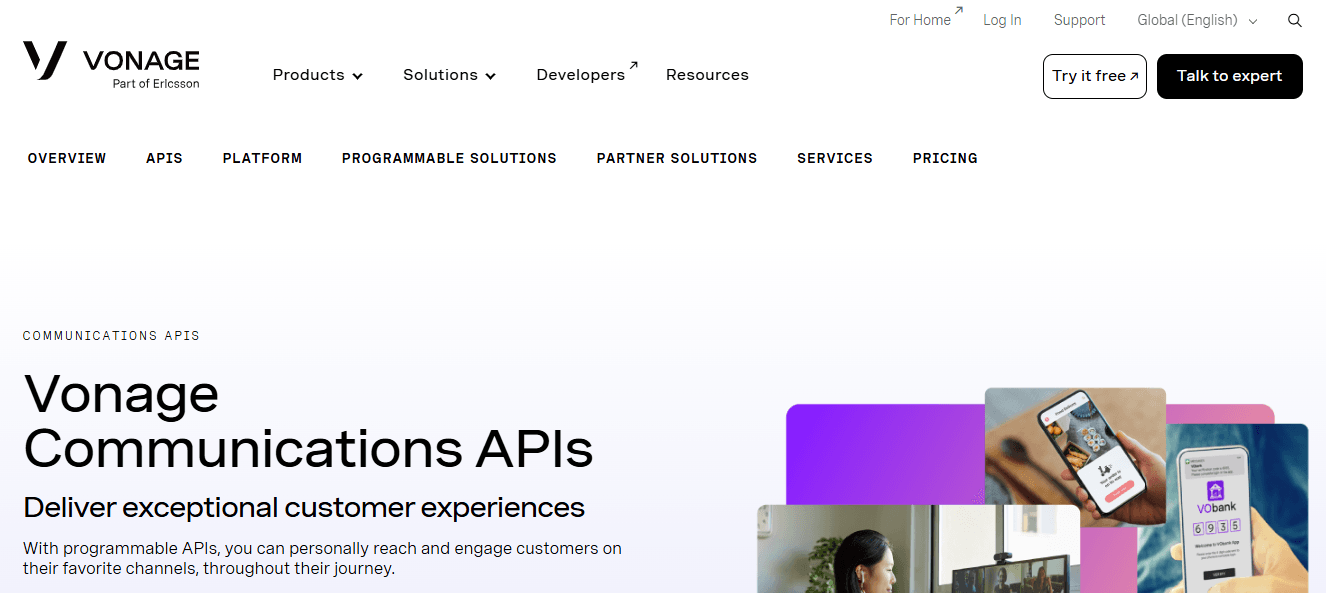
Vonage is an OTP verification API where you predefine a delivery sequence (for example, SMS first, then voice), and the provider executes that sequence and verifies the code.
Best for
Teams that want the provider to handle channel fallback automatically - e.g., trying a second delivery method if SMS is not completed without writing retry or fallback logic in their own application.
This fits teams that 1) need SMS plus a fallback channel and 2) don’t want to manage multiple verification attempts in code.
What you get
- Provider-generated OTPs
- Delivery of OTPs through a predefined channel sequence
- Verification of user-submitted codes
- Verification state responses (pending, verified, failed, expired)
Key endpoints/workflow
Define workflow → send OTP via channel sequence → verify code (per Verify API flow).
Channels
SMS, Voice, Email, WhatsApp
Pros
- Explicit support for channel fallback without custom code
- Multiple verification channels available from a single API
- Clear workflow model that defines how delivery attempts occur
Cons / limitations
More moving parts than SMS-only verification (workflow configuration adds complexity)
Telnyx Verify API
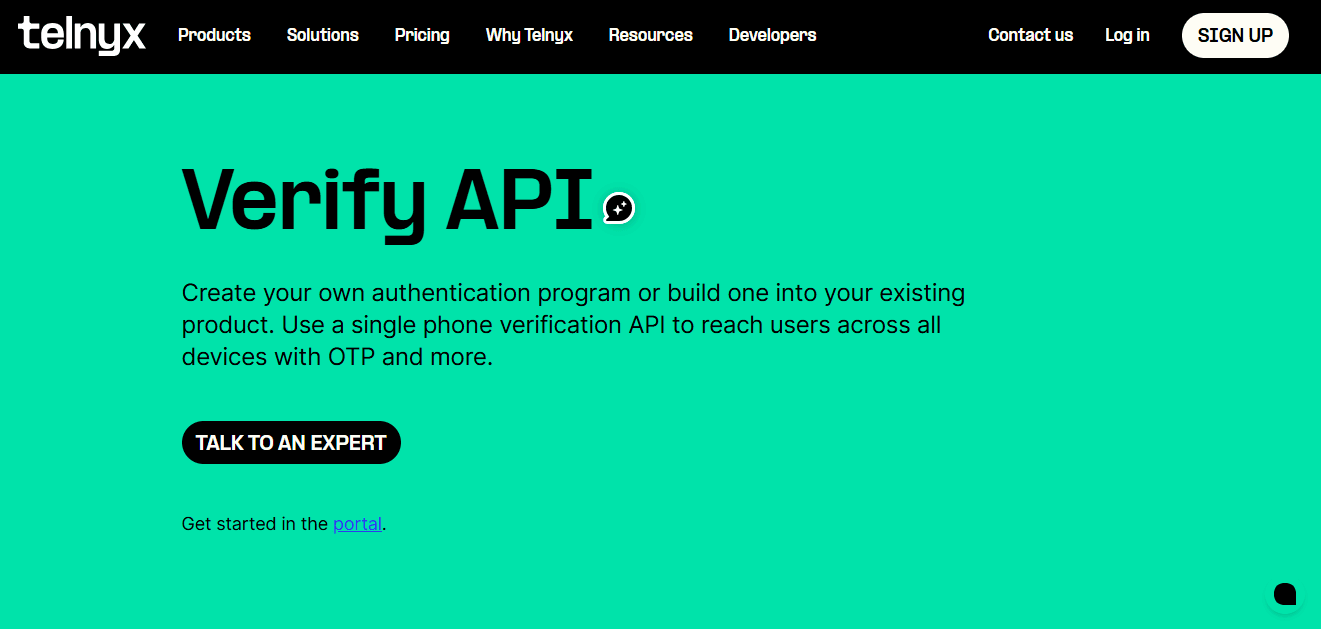
An OTP verification API that supports SMS, voice, and flash call delivery, with endpoints to create a verification request and validate the submitted code.
Best for
Teams that want OTP verification beyond SMS (such as voice or flash call) without building and maintaining their own verification logic.
This fits teams that 1) need non-SMS options like flash call, 2) want provider-managed OTP generation and validation, and 3) are comfortable handling a slightly broader verification setup.
What you get
- Provider-generated one-time passcodes (OTPs)
- Delivery of OTPs via SMS, voice call, or flash call
- An API to initiate a verification request
- An API to validate the user-submitted verification code
Key endpoints/workflow
Create verification request → deliver token → verify token (quickstart shows deliver + verify flow).
Channels
SMS, Voice, Flash call
Pros
- Supports multiple verification methods, including flash call
- Clear, documented create and verify flow
- Good option for teams moving beyond SMS-only OTP
Cons / limitations
- Channel breadth can increase implementation/testing surface area across regions
Plivo Verify API
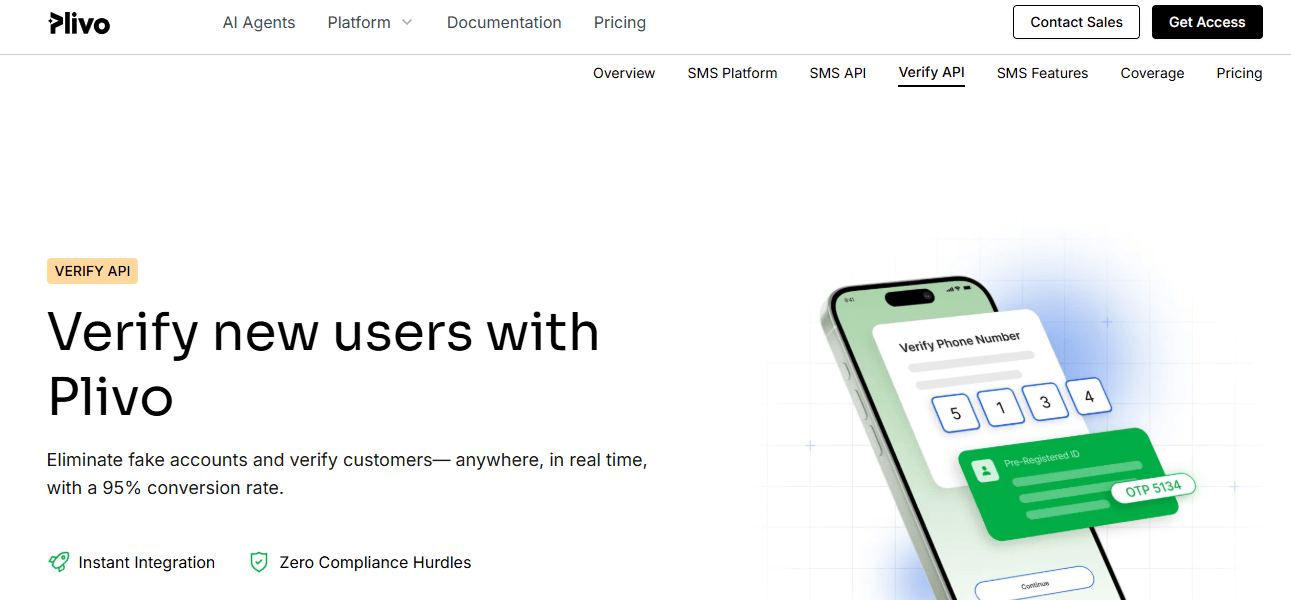
An OTP verification API that supports SMS and voice, without the workflow complexity or channel sprawl of larger CPaaS verification products.
Best for
Teams that need SMS and voice OTP verification and want the provider to handle code generation and validation, without building or storing OTP tokens themselves.
This fits teams that 1) use SMS as the primary channel, 2) want voice as a simple fallback and 3) don’t need flash call, email, or code-less verification methods.
What you get
- Delivery of OTPs via SMS or voice call
- An API to initiate a verification request
- An API to validate the user-submitted OTP
- Verification results indicating whether a code is valid or expired
Key endpoints/workflow
Create verification (session) → send OTP → validate OTP via Verify API.
Channels
SMS & Voice
Pros
- Purpose-built OTP verification API (not generic SMS)
- Voice delivery available as a fallback channel
- Simple, predictable verification flow
Cons / limitations
- Limited to OTP-based verification only
- No support for flash call, email, WhatsApp, or code-less verification
- Less flexibility for complex or multi-method verification strategies
Bandwidth API
An MFA API that lets you generate and verify MFA codes leveraging Bandwidth Voice and Messaging APIs (token generation/management handled for you).
Best for
Teams that want the provider to own the MFA code lifecycle, but are comfortable sending the code themselves using Bandwidth’s SMS or Voice APIs.
What you get
- Provider-generated MFA / OTP codes
- Server-side validation of user-submitted codes
- APIs to create and verify MFA codes
- Compatibility with Bandwidth SMS and Voice APIs for delivery
Key endpoints/workflow
Generate code request → deliver via messaging/voice → verify code validity.
Channels
SMS (messaging) and Voice (per docs stating Voice + Messaging)
Pros
- Provider-managed code generation and validation, so you don’t need to build or store OTP/MFA tokens yourself
- Clear separation between verification logic (Bandwidth MFA) and message delivery (Bandwidth SMS/Voice APIs)
- Works well if you already use Bandwidth for messaging or calling and want MFA without reinventing token handling
Cons / limitations
- Account/product enablement requirements may apply
Sinch Verification API
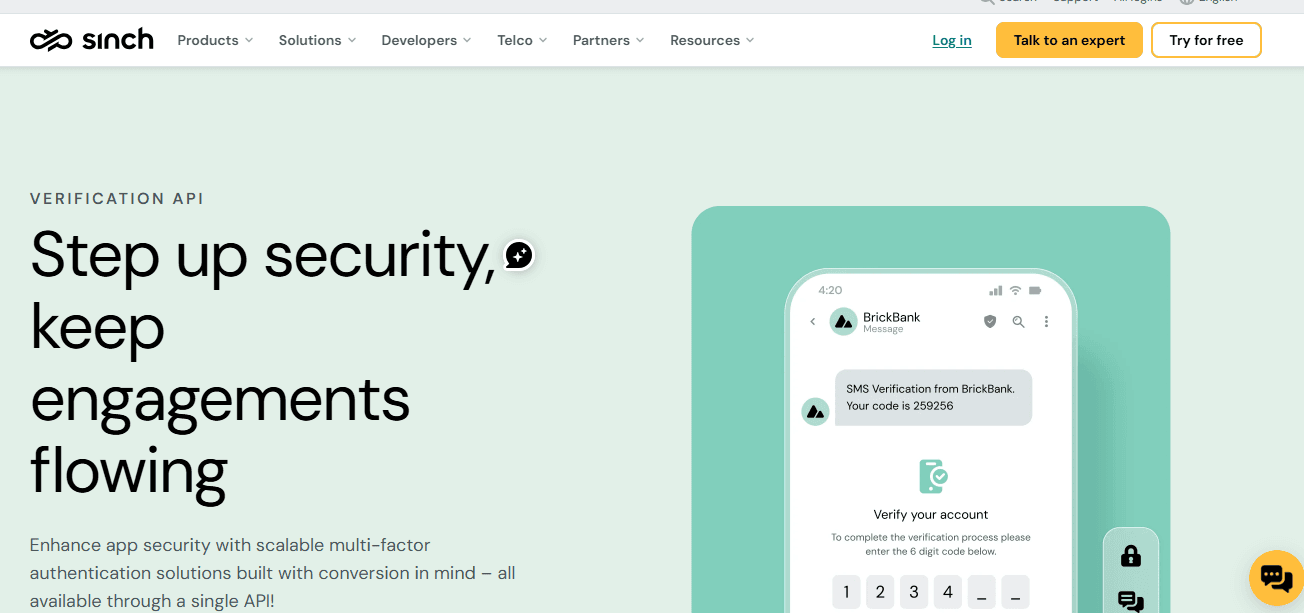
Sinch is a verification API that supports codeless verification methods such as flash call and data verification alongside traditional SMS and voice OTPs.
Best for
Teams who want to verify phone numbers without requiring users to enter an OTP, especially in regions where SMS delivery is slow, unreliable, or expensive.
What you get
- Phone number verification via SMS OTP
- Verification via flash call (missed call pattern)
- Verification via voice call
- Data verification methods (where supported)
- APIs and SDKs to initiate verification and confirm results
Key endpoints/workflow
Request verification → receive SMS/flashcall/call/data method parameters → report/verify back via API (per Sinch flow).
Channels
SMS, Flash Call, Phone Call, Data Verification
Pros
- Broad set of verification methods
Cons / limitations
- Multi-method verification can add integration/testing complexity
Infobip 2FA
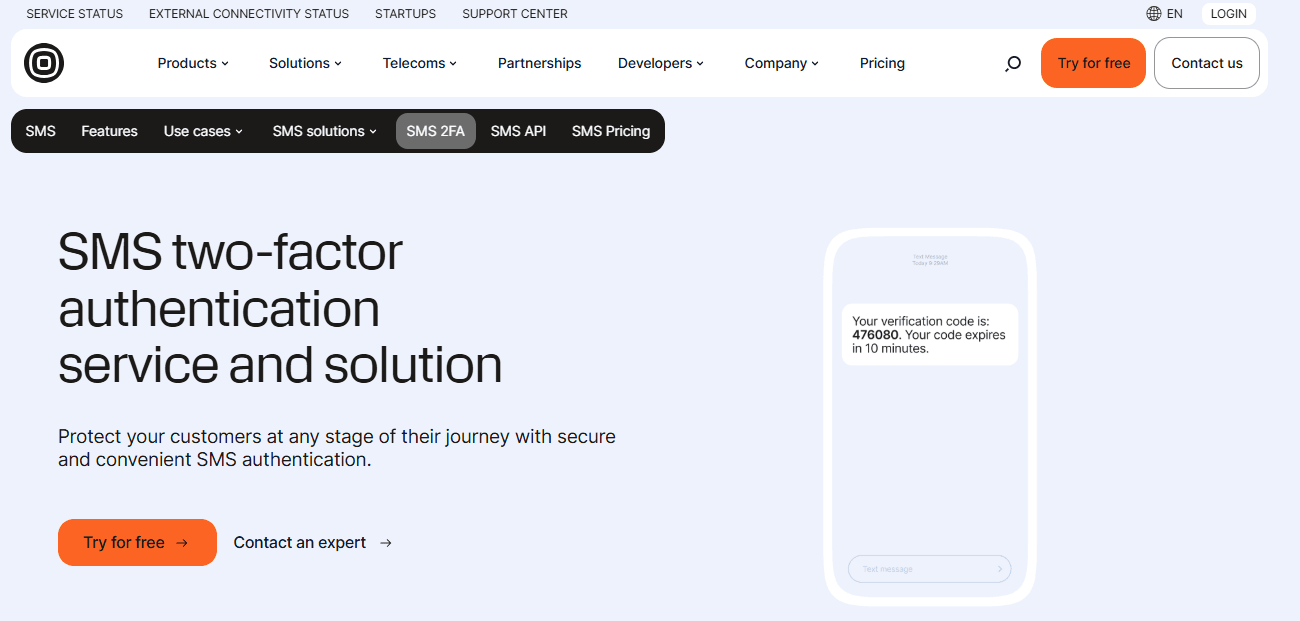
Infobip is PIN-based 2FA service where Infobip generates a verification PIN, delivers it via SMS, voice, or email, and validates the code using a returned identifier (pinId).
This matters because verification is tied to a PIN object, not just a transient OTP send.
Best for
Teams that want provider-managed PIN generation with delivery options beyond SMS, and are comfortable using a PIN–based verification flow rather than a simple send-and-verify OTP call.
What you get
- Provider-generated PIN / OTP codes
- Delivery of PINs via SMS, voice, or email
- A verification API that validates OTPs using a PIN + user-submitted code
- Status responses indicating whether the PIN is valid, expired, or incorrect
Key endpoints/workflow
Send PIN → store pinId → verify OTP by submitting pinId + user code.
Channels
SMS, Voice, Email
Pros
- Supports SMS, voice, and email OTP delivery from a single 2FA service
- Provider-managed PIN generation and validation, reducing custom auth logic
- Well suited to enterprise environments already using Infobip for messaging or communications
Cons / limitations
- PIN–based flow adds integration complexity compared to simple send-and-verify OTP APIs
- Overhead can be unnecessary for SMS-only verification use cases
Twilio competitors: delivery and complexity
| Provider | Delivery channels | Who controls delivery | Setup complexity | |
|---|---|---|---|---|
Mobile Text Alerts | SMS | Application | Low | |
Vonage Verify API | SMS, Voice, Email, WhatsApp | Provider | Medium | |
Telnyx Verify API | SMS, Voice, Flash Call | Application per request | Medium | |
Plivo Verify API | SMS & Voice | Provider | Low | |
Bandwidth MFA API | SMS & Voice | Application | Medium-high | |
Sinch Verification API | SMS, Voice, Flash Call, Data | Provider | Medium | |
Infobip 2FA | SMS, Email, WhatsApp | Provider | Medium |
Which Twilio competitor should you choose?
At this point, the differences between providers aren’t about whether they can send an OTP. They’re about how much control you want, how predictable you need costs to be, and how much logic you’re willing to own.
Here’s a simple way to decide:
-
Choose Mobile Text Alerts if you want a clear SMS-only OTP flow where code generation, delivery, and validation are explicit and easy to reason about as volume grows.
-
Choose Vonage Verify if you want SMS with built-in fallback to voice or email and don’t want to build fallback logic yourself.
-
Choose Telnyx Verify if you need SMS plus non-SMS verification methods (like flash call) and want more visibility into how verification is executed.
-
Choose Plivo Verify if you only need SMS and voice OTP and want a simpler verification API without enterprise overhead.
-
Choose Bandwidth MFA if you want the provider to manage OTP security rules, but you prefer to control exactly how and when messages are sent using SMS or voice APIs.
-
Choose Sinch Verification if you want to verify phone numbers without relying solely on SMS codes, using methods like flash call or data verification.
-
Choose Infobip 2FA if you need OTP delivery across SMS, voice, and email and are comfortable with a PIN-based verification flow.
The right choice depends less on company size and more on how much verification logic you want hidden versus exposed.
If you'd like to see what seamless and predictable OTP verification looks like with SMS, sign up on the Mobile Text Alerts platform for 14 days free.
How to migrate from Twilio Verify to Mobile Text Alerts in just a few days
Switching from Twilio Verify doesn't require a full rebuild.
Use this checklist to move quickly and reduce risk:
1. Map your current flow
Identify where you generate, send, and verify OTPs in Twilio.
Note any logic that needs to be replicated.
2. Replace API endpoints
Swap Twilio Verify endpoints with Mobile Text Alerts’ endpoints.
Update API keys and authentication.
3. Update API calls
Replace Twilio's API calls with Mobile Text Alerts' REST calls.
Confirm request/response handling matches your existing logic.
4. Configure compliance and numbers
Set up sending numbers in Mobile Text Alerts (10DLC, toll-free, or other as needed).
Complete required registrations for your traffic type.
5. Set up a test environment
Import test users or create a staging contact list.
6. Run end-to-end tests
Send OTPs and verify successful delivery.
Check code expiration, retries, and edge cases.
Confirm verification success and failure handling.
7. Deploy in parallel (recommended)
Route a small percentage of OTP traffic through Mobile Text Alerts.
Keep Twilio as fallback during testing.
8. Compare performance
Monitor delivery rates, latency, and error rates.
Confirm parity or improvement before full cutover.
9. Complete migration
Shift 100% of traffic to Mobile Text Alerts once validated.
Monitor closely during initial rollout.
FAQ: Twilio Competitors for SMS 2FA API
What is the best Twilio alternative for SMS OTP verification?
Do all Twilio competitors generate and validate OTPs?
Is SMS OTP still secure enough in 2026?
What’s the difference between OTP, 2FA, and MFA?
Do I need A2P registration for SMS OTP in the US?
Should I build OTP verification myself?
Author Bio
Stella Idemudia Johnson is a B2B SaaS and MarTech content marketer and writer who turns technical ideas into content that’s clear, helpful, and conversion focused.