



While researching for this piece, something Lindsay Marty (CEO of A_bove the Bar Marketing_) said really stuck with me.
“In the work I do at Above the Bar Marketing, helping coaches and small business owners find what actually moves the needle, SMS has become one of the most surprisingly effective tools. I say ‘surprisingly’ because there’s still this idea floating around that SMS marketing is outdated or intrusive—but when it’s done right, it’s the opposite.”
She’s right. SMS is perceived as old school and promotional – but it’s not, especially for client engagement. For coaches, it’s one of the few channels that gives their clients a personal feel, gets seen almost instantly, and doesn’t demand a huge marketing team.
If you’re a coach or entrepreneur looking to turn texts into real client connections, this guide is for you. You’ll learn how to use SMS for client engagement, strengthen relationships, and grow your business with tested templates and real-world results.
Ready? Let’s get to it.
Why SMS Works for Coaching Client Engagement
When smartphones took over, SMS got replaced by apps and automation. Before long, inboxes filled up, newsletters piled on, and notifications flooded in. Attention became harder to earn.
While these communication channels are (still) fighting for a few seconds of attention, SMS is quietly leading again because of its standout qualities: quick, short, to-the-point, and 1:1 feel.
According to one report:
- 83% of consumers say texting is their top mobile activity, compared to 75% for social media and 66% for email.
- 84% of consumers voluntarily subscribed to business texts, showing a 35% rise since 2021 and a steady climb from 79% in 2024.
When Danish Qureshi, General Manager at SEOHUB, experimented with this trend for his client – a fitness coach – by implementing personalized check-ins via SMS, the results were unexpected. The coach saw a 38% increase in attendance and a 52% higher response rate just by sending short motivational SMS mentioning each client’s name and progress milestones.
The preference is clear: people are choosing SMS as their primary way to communicate. For coaches and service-based entrepreneurs, this rising trend is an unmissable opportunity to connect with their audience.
SMS has paved its way as a smarter marketing tool and a relationship channel.
How to Create SMS Campaigns That Drive Client Engagement
High-converting SMS campaigns are strategically designed to feel intentional, relevant, and human, even when they’re automated. For this piece, I interviewed dozens of coaches, marketers, and entrepreneurs asking about their best performing SMS campaigns.
Their answers had a surprising common factor: None of them talked about clever wordplay or promotions. Instead, they made each message feel like part of a real relationship. So rather than pitching their services or sending generic reminders, their messages created a touchpoint for their clients.
Jason Hennessey, CEO of Hennessey Digital, puts it quite aptly when he says, “Each text should serve a clear purpose such as reminding or celebrating. When messages have meaning, clients pay attention.”
This approach was echoed by Andrew Franks, Co-Founder of Reclaim247, who’s seen coaches succeed by implementing personalization driven by behavior: “When messages reflect past actions, like referencing a recent session or challenge progress, clients feel the communication is genuinely relevant, boosting response rates.”
These high-performing messages followed a four-step flow. I call it the 4C Framework:
Connect | Confirm | Coach | Continue
Here’s what it looks like, briefly:
| Stage | Purpose | Example SMS |
|---|---|---|
| Connect | Start with warmth and clarity. | “Hey [first name], welcome to the program! Excited to help you hit your next milestone.” |
| Confirm | Reduce friction, build reliability. | “Hi [first name], your next session is tomorrow at 4 PM. Need to reschedule? Just reply R.” |
| Coach | Add value or motivation. | “You’ve hit week 3 — stay consistent, your effort is paying off 👏.” |
| Continue | Keep momentum with re-engagement or next steps. | “You did great this month! Want to join the advanced track next week?” |
The 4C Framework in Action (Real Examples + Templates)
The 4C Framework looks good on paper (or in a blog post, in this case). But as a coach, how do you make it work? How do you frame messages that get your clients excited about your service?
To understand this let’s see how real coaches and entrepreneurs have used the 4C Framework — Connect, Confirm, Coach, Continue — for building 1:1 rapport with their clients.
Remember: The best SMS campaigns are ones that are hyper-personalized and respond to behavior. When the right message meets your client at the right moment, it feels like help even though it’s marketing.
1. Connect
One of the most powerful examples of connection came from Dario Ferrai, Head of Marketing at All-in-One AI. His team noticed hundreds of trial users signing up on email, exploring briefly, and disappearing. As a desperate measure, they set a simple SMS trigger: “Looks like you paused. Want a 5-minute walkthrough to get the most out of your trial?”
Within two weeks, 27% of inactive users re-engaged, and 11% converted to paying customers — a 10x improvement over their email-only campaigns.
The SMS trigger worked because they just offered to help. It met the users at their drop-off stage and made it easy for them to respond. Now imagine the outcome if they had sent more links or discount codes – the clients would have left for good.
While Dario's example is from SaaS, coaches can apply the same principle — whether for new clients or re-engaging dormant ones, i.e., meet clients where they dropped off and offer help without pressure.
Templates You Can Try:
Hey Alan, you haven’t booked this week’s session yet. Want me to help you plan your next focus area?
Hi Rachel, checking in — how’s your week going? Need help staying on track with your goals?
Most SMS platforms allow you to set up behavior-based triggers that automatically send messages when clients become inactive or miss key milestones.
2. Confirm
Let’s look at how Dr. Jonathan Wong of Renovo Endodontic Studio, communicates with his clients:
“Hi Sarah, just confirming your appointment for tomorrow at 3 PM. Reply R if you need to reschedule.”
For Dr. Wong, this message works because it feels personal and uses the same tone he uses in person. And since the appointment reminder is friendly with clear instructions, it becomes a part of client experience. Over time, clients start to associate his messages with reliability rather than promotion.
In service-based businesses like coaching, messages like these reduce friction and build credibility. When you value your clients’ time and make it easy to engage, they respond faster and stay longer.
Templates You Can Try:
Hey Alex, looking forward to our session tomorrow at 4 PM. Need to reschedule? Just reply R.
Hi Lori, quick reminder for tomorrow’s call — here’s your prep worksheet: [link].
For small teams, automating such reminders can save hours of back-and-forth every week while maintaining that personal touch.
3. Coach
Coaching becomes most effective when it surpasses the student-teacher dynamic and shifts to friendly guidance. This is where client engagement deepens, with one-way messages becoming two-way conversations.
Lisa Richards, creator of The Candida Diet, strategically changed her one-way texts to simple, interactive prompts. She believes this makes her clients feel heard and builds rapport:
“We frequently include easy, low-friction reply options like, ‘Having a hard time with sugar cravings today? Reply YES for our 3 coping methods.’ This turns a one-way message into a two-way conversation, which makes the member feel listened to and supported proactively. These conversation starters have shown us an impressive 38% response rate.”
Remember: coaching thrives on responsiveness. When clients can reply easily, they move from passive receivers to active participants. These tiny two-way conversations are great for both parties, because:
- They build accountability and keep your clients motivated with the kind of engagement they get in live sessions.
- Your micro-involvement gives you deep, personal insights into your clients that help you personalize support and even spot upsell opportunities.
Managing this kind of personal back-and-forth at scale can quickly become time-consuming. Automation tools can help by sending timely nudges and adapting follow-up messages based on client responses, so you stay personal without the manual effort.
Templates You Can Try:
Feeling stuck with your business goals today? Reply YES if you want 3 fast clarity questions.
Did you finish your mindset exercise today? Reply DONE and I’ll send a quick reflection prompt.
4. Continue
Not every client stays consistent. Messages get missed with shifting priorities. As a coach you can gently nudge such clients back to your service. The best way to do this is to remind them of their progress and help them find their rhythm again.
Re-engagement messages work because they’re timely and relevant. They also help in building long-term client relationships while preventing drop-offs. The principle to follow essentially is this: follow up when someone shows interest but doesn’t book, and do it with value, not pressure.
Templates You Can Try:
Hey Kevin, noticed you’ve been quiet lately. Want to join our new 4-week challenge? Here’s a sneak peek: [link].
You’ve done great work so far. Ready for the next level? New spots just opened in the advanced program.
Scheduling follow-up messages based on inactivity triggers ensures your outreach happens when it's most relevant, without you having to manually track every client.
Personalization Strategies for Higher Client Engagement
According to Twilio’s State of Personalization Report, 89% leaders believe personalization will be critical to their company’s success over the next three years.
But just adding your client’s name isn’t personalization. It needs to be context driven. This means creating messages that identifies and corresponds to each client’s progress stage.
Here’s how it may look:
New joiner: welcome + onboarding
Example:
Hey [first name], welcome aboard! Here’s a quick guide to get started. Type Q if you have further questions.
Mid-Program: encouragement + accountability
Example:
You’ve completed 50% of your program, [first name]. Keep that momentum going!
Alumni: check-in + upsell
Example:
Hi [first name], Our last session was great! Many from your last batch are joining our new 6-week focus group. Would you like to reserve a spot?
The trick to hyper-personalized messages is in segmenting your client list. When you tag clients by stage, behavior, or engagement level, they naturally lead to the next step and build continuity in your client relationships.
The challenge lies in staying consistently relevant at scale. That’s where automation comes into play. Once you set it up to your preferences it enhances personalization without losing your voice.
Here’s how you can build an effective and ethical list while keeping messages personal:
| What to Do | Why It Matters | How to Execute |
|---|---|---|
| Get explicit consent | Ensures trust and legal compliance | Use text-to-join keywords, QR codes, or embedded opt-in forms that sync to your CRM |
| Deliver immediate value on opt-in | Sets expectations and reduces churn | Send a welcome message with a checklist, mini-guide, or onboarding link |
| Segment by journey stage and behavior | Keeps messages relevant and timely | Tag contacts as new, active, paused, or alumni; create segments for milestones or inactivity |
| Use two-way, low-friction prompts | Converts one-way pushes into conversations | Deploy simple YES/NO prompts or reply keywords to trigger follow-up flows |
| Control frequency by segment | Prevents fatigue and lowers unsubscribes | Schedule different cadences per segment (e.g., onboarding daily, ongoing weekly) using drip campaigns |
| Track and prune inactive contacts | Improves deliverability and engagement | Remove non-responders after a set period and re-engage with targeted win-back flows |
| Respect opt-outs and log consent | Protects reputation and compliance | Most SMS platforms (like Mobile Text Alerts) auto-manage STOP replies and store consent timestamps |
Once your list and personalization are in place, the next step is to measure what’s working.
How to Measure SMS Client Engagement
Not every message gives you engagement or results. The only way to tell what’s working is to track and analyze your data — otherwise, “marketing without tracking” really does turn into expensive guessing.
Start with three core numbers: response rate, unsubscribe rate, and conversion ratio. These simple metrics will tell you whether your texts are connecting or confusing.
Our suggested numbers to look out for coaching SMS:
- Response rate of 20-30% is strong for coaching client engagement. If you’re seeing under 10%, your messages may be too generic or mistimed.
- Opt-out rate under 2-3% per campaign is healthy. If opt-outs exceed 5%, you're likely over-messaging or sending content that doesn’t align with what clients signed up for.
- Click-through rate of 15-25% (when including links) indicates your call-to-action is clear and compelling.
- Conversion rate of 10-15% (from message to booking/action) shows your SMS is driving real business outcomes.
J.R. Farris from Accountalent shares his perspective, “If there’s high engagement in a campaign but poor conversion, it means the offer isn’t clear — not that the system failed.” In one case, he saw a client increase conversions from 6% to 19% just by tightening a call-to-action from a paragraph into a single crisp sentence.
Keep your testing focused. Adjust one variable at a time — tone, timing, or call-to-action — and track results over a few sends. Make small, steady refinements to A/B test your campaigns and double down on the ones that work.
When to Pause or Pivot:
- If your opt-out rate exceeds 5% for two consecutive campaigns, pause and reassess your frequency and messaging
- If response rates drop below 8% consistently, test new message formats or timing windows
- If you see engagement spike but conversions stay flat, your CTA needs work — not your audience
| Focus Area | What to Track | Why It Matters | How to Measure |
|---|---|---|---|
| Engagement | Click-through and reply rates | Shows how relevant and timely your messages are | Track link clicks and direct replies; compare across campaigns |
| Retention | Opt-out trends and re-engagement rates | Helps spot fatigue before it hurts trust | Monitor unsubscribe patterns by message type and frequency |
| Timing | Send time and day performance | Finds the engagement “sweet spot” for your audience | Test different send windows and track response velocity |
| Conversion | Click-to-book or reply-to-purchase | Ties engagement to real business outcomes | Measure actions taken within 24–48 hours of message |
Most SMS platforms provide built-in analytics dashboards that make tracking these metrics straightforward, even if you’re not a data expert. Review your numbers weekly and let the data guide your next move.
Solutions That Make SMS Client Engagement Easy
Building personalized, behavior-driven SMS campaigns doesn't require a full marketing team. The right platform can automate timing and triggers while keeping your messages personal.
Here’s what to look for in an SMS platform for coaching:
- Segmentation and tagging to organize clients by journey stage
- Behavior-based triggers that send messages when clients take (or don’t take) specific actions
- Two-way messaging with smart reply options that create conversations
- Scheduling and drip campaigns to maintain consistent touchpoints without overwhelming clients
- Analytics dashboards to track what's working and optimize over time
Mobile Text Alerts is great for this kind of client engagement. It offers all the features above with a simple interface that doesn’t require technical expertise — making it ideal for coaches, entrepreneurs, and small business owners who want dependable business texting without the hassle.
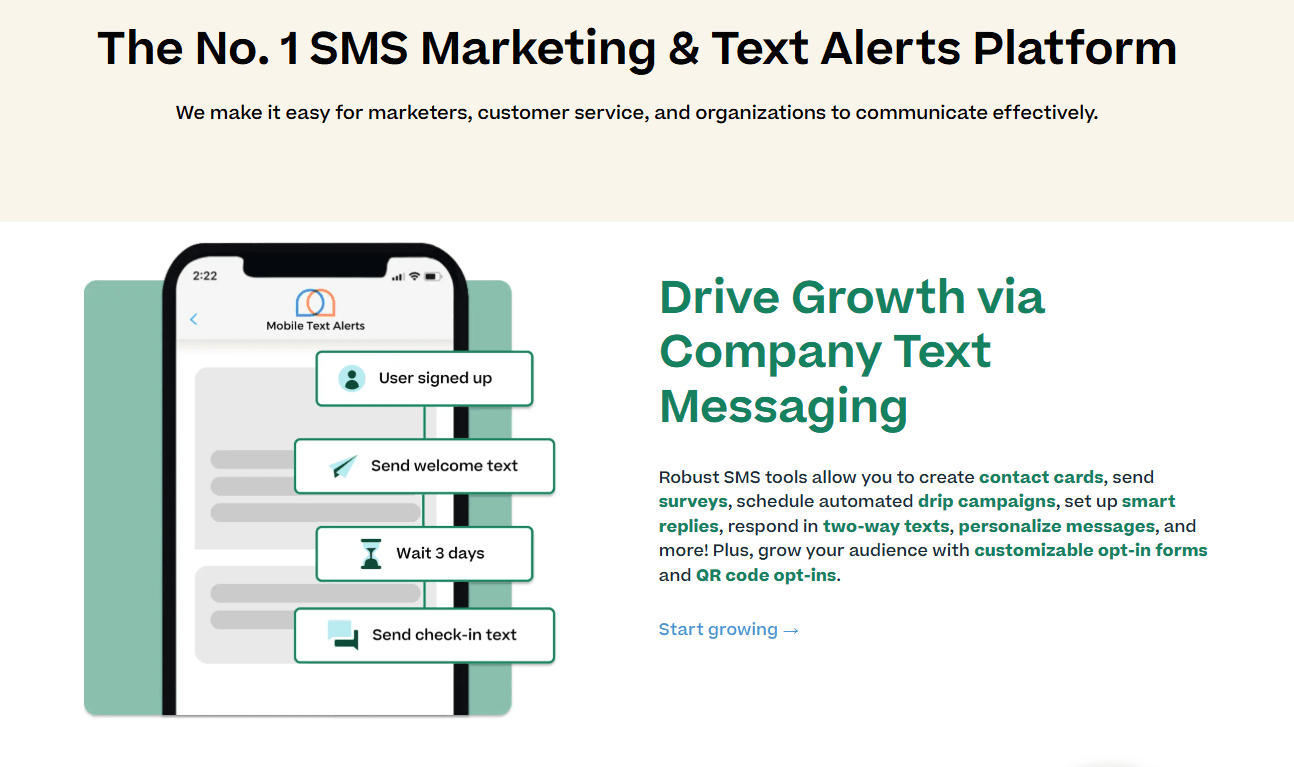
Ready to connect with clients without the extra work? Test Mobile Text Alerts free for 14 days and see how automation and personalization actually work together.
Best Practices for Effective SMS Campaigns
Now that you know the anatomy of the most effective SMS marketing messages, let’s take a look at a few pointers you should keep in mind before hitting send:
Don’t spam: J.R. Farris from Accountalent saw campaigns lose 40% of subscribers in one month by sending five or more texts weekly. Ideally, send one or two personalized messages per week that deliver real value.
Take clear consent: You can’t just start texting people. Always get explicit opt-in and follow TCPA compliance rules to avoid legal issues and losing subscriber trust.
Test time slots: Depending upon your service, choose a time slot that’s convenient for clients. Texting at the wrong time (late night, early morning, or during work hours) kills engagement.
Avoid promotional messages without relevance: If you can’t tie your text to something measurable or immediately helpful, don’t send it. Purely promotional messages without a service basis erode trust fast.
The Bottom Line
If there’s one thing to take from this guide, it’s this: SMS works best when it feels like support, rather than a sales pitch.
Uku Soot from IPB Partners puts it perfectly: “A coach’s greatest asset is the trust they have with a client, so sending a quick message of encouragement in between sessions does a lot more to reinforce your value than any discount ever would.”
That’s the difference between coaches who see SMS as just another marketing channel and those who use it to build long-term client loyalty. The winners aren’t mass promoting their services. They’re building sustainable client communication strategies, segmenting their audience, and treating every text like a 1:1 conversation.
Your next step is simple. Pick one template from this guide. Test it with 10 clients this week. Track what happens. Then refine and repeat.
SMS for coaching client engagement is about reaching the right person at the right moment with the right message. Get that formula right, and your clients will look forward to hearing from you.
Ready to start building stronger client relationships? Try Mobile Text Alerts free for 14 days and see how meaningful messages drive measurable results.
FAQs
1. How do I make sure my SMS campaigns stay compliant?
Always collect explicit consent before sending marketing texts. Use clear opt-in methods like forms, QR codes, or “Text-to-Join” keywords. Every message should identify your business and include an easy way to opt out (for example, “Reply STOP to unsubscribe”). Tools like Mobile Text Alerts automatically include compliance language and manage opt-outs for you.
2. How often should coaches text their clients?
One to two message per week is a good number. You can slowly increase the frequency as your audience becomes more engaged. As Sami Andreani of Oppizi points out “Every message must earn its place by being immediate, helpful, or emotional, rather than being promotional.”
3. What time of day is best for sending messages?
Mid-morning (around 10–11 AM) and early evening (5–8 PM) in your client’s time zone tend to give the highest engagement, since people are less busy and more likely to read and respond. Test different windows with your audience and track engagement to find your sweet spot.
4. Can I use automation without sounding robotic?
Yes. Use automation for timing and triggers but write messages like you’re texting a friend; (use their name, reference specific details about their progress, etc.). Build in natural reply options (“Reply YES if you need help”) that lead to real conversations. The key is to automate the when, not the personality – your messages should still sound like they came from you, even if the system sent them.
Special ShoutOut to the Experts for Sharing Their Wisdom
- Lindsay Marty, CEO at Above the Bar Marketing
- Danish Qureshi, General Manager at SEOHUB
- Jason Hennessey, CEO at Hennessey Digital
- Andrew Franks, Co-Founder at Reclaim247
- Dario Ferrari, Head of Marketing at All-in-One AI
- Dr. Jonathan Wong, Owner and Endodontist at Renovo Endodontic Studio
- Lisa Richards, CEO and Creator of The Candida Diet
- J. R. Farris, CEO at Accountalent
- Uku Soot, Growth Strategist at IPB Partners
- Sami Andreani at Oppizi