



Explore this content with AI
Manual follow-ups don’t scale.
If you’re relying on your team to send every message, you’re leaving revenue on the table.
Automation changes that.
With the right SMS platform, you can trigger messages based on behavior, timing, and customer actions.
SMS gives you a way to stay connected without being intrusive. It is one of the most direct channels available—open rates near 98%, messages read within minutes, and no algorithm standing between you and your customer. But not every SMS provider is built for sales workflows. Some are better for bulk promotions, others for e-commerce triggers, and others for CRM-driven sales conversations.
The right platform helps you follow up, nurture prospects, and close deals faster.
In this guide, we break down the best SMS platforms for automated sales—so your system works even when you’re not.
What makes a great SMS marketing provider for automated sales?
Not all SMS platforms are built the same. Most can send a bulk text. Fewer are actually designed to help you close deals. Here's what separates a sales-focused SMS platform from a basic broadcast tool.
Two-way messaging
Sales happen in conversations. Yet in 2025, 53% of consumers who texted a business never got a reply—meaning over half of potential sales conversations died before they started. A platform with real two-way messaging lets your team answer objections and move a customer from curious to converted inside a single thread.
Automation triggers
There's a big difference between blasts and behavior-triggered messages. A triggered message hits someone at the exact moment they're ready to act. Loverboy Inc. used Mobile Text Alerts' automated launch alerts to generate 1,500 orders on day one and sell 50% of inventory before the official release date.
CRM integration
This feature is a non-negotiable for sales teams. Without CRM sync, you risk running two separate conversations with the same customer and missing the handoff. Every text should be logged, every follow-up automated, every lead tied to a pipeline stage. Deep integrations with HubSpot, Salesforce, and ActiveCampaign are what separate a real sales tool from a basic messaging app.
Segmentation
Blasting your whole list is how you rack up opt-outs. Personalized SMS drives a 16% conversion rate — nearly double the channel's 8.5% average. Platforms that let you segment by purchase history, cart value, location, or funnel stage give you that precision without requiring a data team to pull it off.
Compliance and deliverability
The TCPA governs US SMS marketing, mandating explicit opt-in before any marketing message. Under 47 U.S.C. § 227, violations carry a $500 penalty per text—up to $1,500 for willful violations—and with TCPA class action filings up 268% year over year as of early 2025, the risk is real. A solid platform handles opt-in management, consent tracking, and quiet hours automatically, keeping your list clean and your business protected.
The best SMS marketing providers for sales (2026)
- Mobile Text Alerts — Best SMS marketing platform for automated sales
If you run a retail store, a local service business, or any operation where speed and simplicity matter more than enterprise-level automation, Mobile Text Alerts is built for you. You can set up your account and send your first campaign in under five minutes—no developer, no onboarding calls, and no lengthy configuration. For retail businesses running a flash sale, that speed directly translates to revenue.
Unlike platforms that charge hidden carrier fees on top of your subscription, Mobile Text Alerts covers all messaging fees in your plan and rolls over unused credits, so your costs stay predictable whether you're sending 500 texts or 50,000. Pricing transparency matters when you're running frequent promotions, and you need to know exactly what your margins look like.
Its group-based segmentation lets you target specific customer lists without needing a data team. Automated drip campaigns handle follow-ups, reminders, and re-engagement sequences on autopilot, so your retail SMS marketing efforts don't stop when your team clocks out. And when you need help, you get live human support—not a bot.
On G2, the feedback tells a consistent story. One verified reviewer — a university instructor who tested over a dozen SMS platforms before making a decision — put it this way:
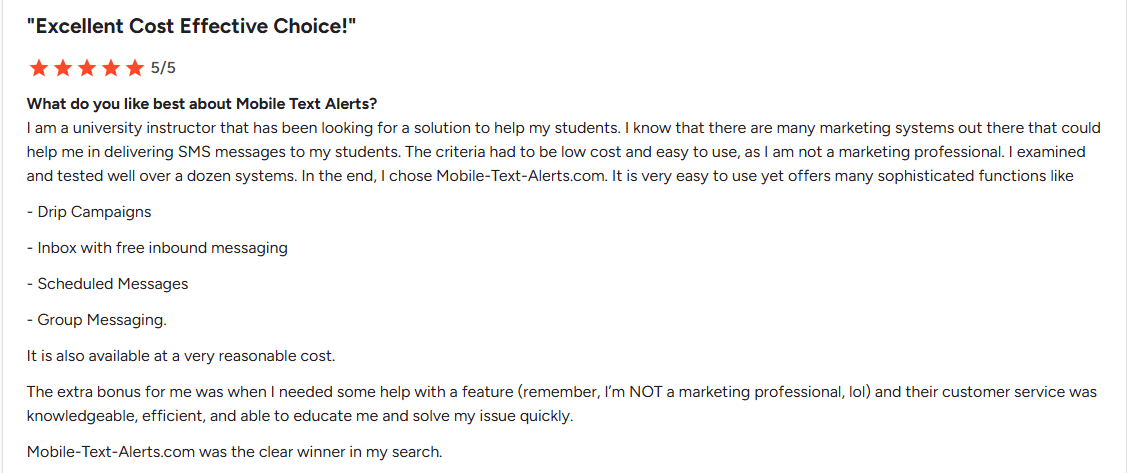
Image: G2
This is the experience of a non-marketer getting up and running quickly, with prompt support when needed. G2 has recognized Mobile Text Alerts with six awards, including Best Estimated ROI, Fastest Implementation, and Easiest to Do Business With, all based on verified customer feedback. These aren't participation trophies—G2 calculates ROI awards based on actual time-to-value reported by users.
Klaviyo — Best for e-commerce brands ready to scale
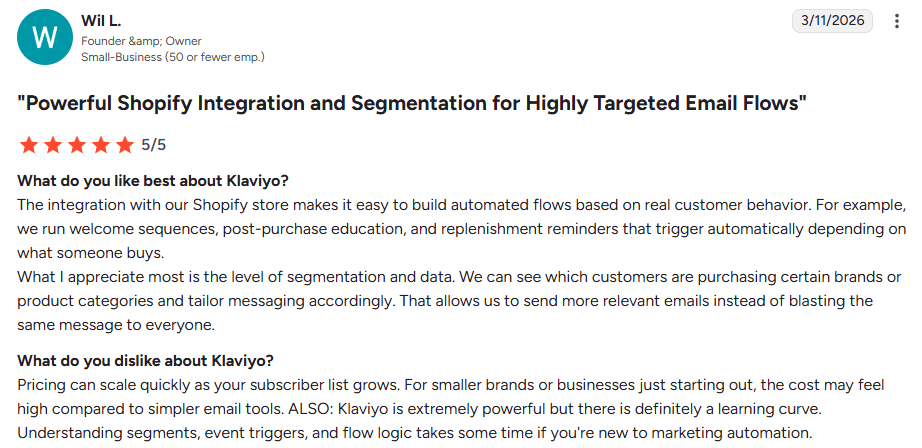
Klaviyo's strength is that it knows your customers better than almost any other platform—every click, purchase, and cart abandonment feeds into unified profiles powering its segmentation engine. An abandoned cart sequence can send an email first, then fire an SMS two hours later if the customer hasn't converted, all inside a single flow. This eliminates the attribution confusion that comes from running email and SMS on separate platforms.
Users consistently praise the platform for its powerful automation, seamless Shopify integration, and segmentation depth.
But the pricing concern shows up just as consistently—flagged in 57 separate G2 reviews unprompted. Klaviyo's 2025 pricing restructure moved to active profile-based billing, meaning costs scale automatically as your list grows, whether you're ready for that jump or not. Smaller businesses regularly report feeling priced out as their audience expands.
Salesmsg — Best for sales teams and CRM workflows
Recognized as a 2025 Inc. 5000 company, the core of Salesmsg's value is its two-way conversational texting built directly into your CRM pipeline. When a lead responds to a text, their reply goes to a shared inbox, allowing your sales team to view the entire conversation history, the contact's deal stage, and all previous interactions without switching tools. Every message sent and received is automatically logged in your CRM, ensuring that nothing is overlooked and no follow-up is missed.
For sales workflows specifically, Salesmsg supports triggered SMS sequences based on CRM deal stages—meaning you can automatically send a text when a HubSpot deal moves to a new pipeline stage or when a Salesforce opportunity reaches a certain value. SaaS Academy used Salesmsg to send SMS reminders and follow-ups after demos, cutting demo no-shows by 20% and generating an extra $90,000 in monthly revenue.

image: cuspera
On G2, Salesmsg holds a strong rating with over 370 verified reviews. According to aggregated G2 feedback, the most praised aspects are ease of use—mentioned by 141 reviewers; easy communication (74 mentions); and seamless CRM integrations (66 mentions). The HubSpot integration alone is called out in 58 separate reviews as a standout strength.
The honest limitations: G2 reviewers flag occasional mobile app performance issues (22 mentions), some delayed text delivery, and a desire for more customization in reporting and analytics. For teams that need deep mobile functionality, this is worth factoring in.
Attentive — Best for enterprise e-commerce brands
Attentive’s core strength lies in AI-driven personalization at scale. Its identification technology, which matches anonymous website visitors to existing subscriber profiles, can deliver a 30–40% lift in new subscribers when enabled, according to G2 reviewers. Its behavioral triggers also allow brands to send SMS messages based on real-time customer actions throughout the purchase journey, with each message tailored using individual customer data.
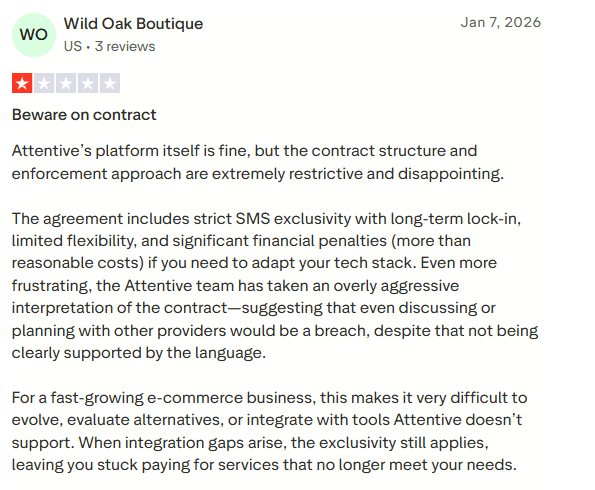
Across platforms like G2, Trustpilot, and Capterra, feedback around pricing and contract structure comes up frequently. Attentive uses a custom pricing model and typically operates on quarterly minimum commitments, often in the $2,000–$3,000 range, with contract terms that can span 6 to 12 months. Some reviewers note that this structure may require more upfront commitment compared to more flexible, usage-based platforms, particularly for teams that anticipate needing to adjust their messaging stack over time.
Source: Trustpilot
Most analysts suggest Attentive only makes financial sense for brands doing $50,000+ monthly revenue, with SMS already accounting for a meaningful share of total orders.
SimpleTexting — Best for small businesses
SimpleTexting's strength is breadth without complexity. You get mass texting, two-way conversations, drip campaigns, autoresponders, and list growth tools—all from a clean dashboard that requires minimal training. The AI Assist tool generates five ready-to-send message options from a single prompt, making it easy to run A/B tests and consistently send copy that converts without spending hours writing it.
For small businesses specifically, the two-way inbox is a genuine sales tool. Replies land in a shared inbox where team members can respond, assign conversations, and leave internal notes — turning what could be a one-way broadcast into an actual customer conversation. Incoming SMS messages are free, which keeps costs predictable even as reply volume grows.
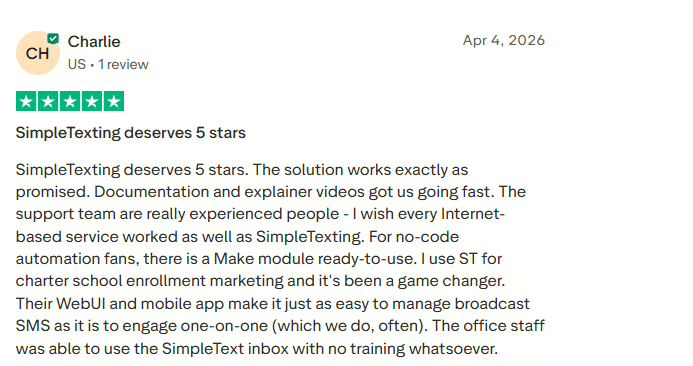
SimpleTexting earns consistent praise for customer support quality and ease of use.
Source: Trustpilot
The honest limitations: Some users report occasional delivery delays during high-volume sends, and the pricing jumps between tiers can feel abrupt—going from affordable to significantly pricier without many mid-range options. G2 reviewers also note that CRM integrations rely heavily on Zapier rather than native connections, which adds friction for teams that need deep workflow automation. For businesses that have outgrown basic SMS and need complex CRM-driven workflows, SimpleTexting will eventually feel limited.
Postscript — Best for Shopify brands
Postscript's edge is its depth of Shopify integration. Every segmentation filter, automation trigger, and customer data point pulls directly from your live Shopify store.
One feature worth highlighting is CashBack—Postscript's alternative to discount coupons. Instead of offering a percentage off that eats into margins, CashBack gives subscribers a store credit after purchase, which drives conversions while protecting profitability. For brands that rely heavily on promotions to drive SMS sales, this feature is a real differentiator.
On G2, users consistently praise customer support responsiveness and the intuitive campaign builder. The most recurring criticism across G2 and independent reviews is attribution accuracy — like many SMS platforms, Postscript's native reporting tends to over-attribute revenue to SMS. Most experienced users rely on Google Analytics or Shopify's own analytics as their source of truth. Paid plans are also noted as pricier than some competitors', and the platform is strictly for the US and Canada—international brands will need a separate solution.
The most important limitation: Postscript only works with Shopify. WooCommerce, BigCommerce, or any other platform—this option is not available.
| Provider | Best For | Key Strength | Main Drawback |
|---|---|---|---|
| Mobile Text Alerts | Retail & local business | Fastest setup, included carrier fees, credit rollover, live US support | Less suited for complex e-commerce automation |
| Klaviyo | E-commerce scaling | Unified email and SMS from one customer data source | Expensive as list grows, steep learning curve |
| Salesmsg | Sales teams & CRM | Native HubSpot and Salesforce integration, two-way conversational texting | Not built for broadcast marketing or retail promotions |
| Attentive | Enterprise e-commerce | AI personalization at scale, white-glove onboarding | 6–12 month contracts, $2,000–$3,000 quarterly minimum |
| SimpleTexting | Small businesses | Easy to use, all features included on every plan | CRM integrations rely on Zapier, with no native connections |
| Postscript | Shopify brands | Deepest Shopify integration on the market, 4.9/5 on G2 | Shopify only, US and Canada only |
Best SMS Marketing Providers by Sales Use Case
SMS marketing for e-commerce
E-commerce brands get the clearest ROI from SMS through abandoned cart recovery, flash sales, and back-in-stock alerts. One growth team found a single SMS drove 40% of total conversions in under six hours—compared to 15% from email over three days. Shopify brands with high volume should look at Postscript. Brands that scale email and SMS together will get more from Klaviyo. For quick setup and predictable costs, Mobile Text Alerts handles automated e-commerce SMS campaigns without the technical overhead.
SMS marketing for retail
Retail runs on urgency—flash sales, new arrivals, and limited-time offers all need a channel that lands in seconds. One retail CEO reported a 25% sales increase from well-timed, personalized texts to returning customers. For local retailers, Mobile Text Alerts delivers within five minutes at peak volume with no hidden carrier fees. Enterprise brands needing AI-driven behavioral targeting should look at Attentive.
SMS marketing for small businesses
Small businesses need results without complexity or unpredictable costs. Mobile Text Alerts is the top pick—rated Best Estimated ROI and Fastest Implementation on G2, with all features included from the entry plan. For setup specifics, the plug-and-play SMS guide for small teams covers the exact process.
SMS marketing for sales teams
Research from the Salesforce SMS guide shows the first business to respond to a new lead wins it—and an instant SMS ensures that's you. Teams running a full pipeline through HubSpot or Salesforce will get the most from Salesmsg. Smaller teams that need lead nurturing without the CRM complexity will find Mobile Text Alerts a more accessible starting point.
How businesses actually use SMS to generate sales
Here are the five workflows where SMS consistently drives the most revenue.
Lead follow-up
Speed is everything in lead conversion. Automated SMS flows generate up to 30x more revenue per recipient than one-off messages when triggered within 60 seconds of a new lead. The workflow is simple: the lead enters the CRM, SMS fires automatically, and a conversation starts before a competitor even sees the notification.
Abandoned cart recovery
Over 70% of online shoppers abandon their carts before checkout, but SMS is one of the most effective ways to bring them back. Abandoned cart SMS converts at between 24.6% and 39.4% — significantly higher than email's average of 5–10% for the same use case. Timing matters: messages sent within 15 to 30 minutes of abandonment consistently outperform those sent hours later. A simple sequence works well for most brands—a reminder at one hour, a follow-up at 24 hours, and a final message with a discount offer at 48 hours if the cart is still unclaimed.
Flash sales and limited-time offers
SMS is the highest-ROI channel for time-sensitive promotions. Limited-time SMS offers convert at twice the rate of equivalent email campaigns, and 94% of SMS opens happen within three minutes of delivery. One retail brand cleared 64% of its inventory within three hours of a single flash sale text. Pair urgency with specificity—"20% off everything—ends at midnight" consistently outperforms vague announcements.
Appointment-based sales
For any business whose revenue depends on showing up, SMS reminders are one of the highest-leverage tools available. SMS appointment reminders convert at 23.8% and reduce no-shows by an average of 22%. A two-touch sequence—24 hours and one hour before—is the standard most businesses find most effective.
Post-purchase upsells
The easiest sale is to someone who has just bought. Post-purchase SMS sequences convert at 14.6%–33.3%, and customers engaged via SMS spend an average of 22% more—use what you know to make the next message feel like a recommendation.
SMS sales strategies that actually increase conversions
Picking the right SMS platform gets you halfway there. The other half is knowing what to send, when to send it, and how to structure campaigns that people actually respond to. Here are the five strategies that consistently drive sales.
Flash sale countdown texts
The difference between a forgettable flash sale text and one that clears inventory is specificity. Keep it short, make the deadline real, and link directly to the offer. The flash sale SMS templates guide has ready-to-use structures if you need a starting point.
VIP early access offers
People who feel like insiders buy differently from people who feel marketed to. Give your SMS subscribers access to a sale or product drop before anyone else, and you turn a promotion into a privilege.
Cart recovery sequences
The approach that consistently works is three touches — a reminder at one hour, a follow-up at 24 hours, and a discount offer at 48 hours if the cart is still sitting there. Timing matters too: messages sent within 15 to 30 minutes of abandonment outperform those sent hours later.
Product launch alerts
Your SMS list is made up of people who explicitly said they want to hear from you, which makes it the best possible audience for a product launch. The product launch SMS strategy behind Loverboy Inc., selling 50% of their inventory before their official release date, is a good example of such campaigns done well.
Re-engagement campaigns
Every SMS list has subscribers who have gone quiet. Before you write them off, a simple win-back sequence is worth sending. Subscribers who re-engage after a win-back tend to be more loyal than average—they just needed a nudge, not a discount.
How to choose the right SMS marketing provider for your business
Before committing to a platform, ask yourself these questions:
Do you need automation? If yes, look at Mobile Text Alerts, Klaviyo, or Postscript. If basic broadcasts are enough, SimpleTexting works well.
Do you need CRM integration? If yes, and your team lives inside HubSpot or Salesforce, Salesmsg is the obvious choice. The majority of the platforms on this list are suitable for lighter Zapier-based connections.
Do you need e-commerce triggers? If yes, and you're on Shopify, go with Postscript or Klaviyo. Mobile Text Alerts handles the essential use cases for everything else without adding any complexity.
How many messages per month? Under 2,000 → Mobile Text Alerts or SimpleTexting. Scaling toward 20,000+ → Klaviyo or Salesmsg. Enterprise volume → Attentive, but read the contract first.
Sign up for a 14 day free trial with Mobile Text Alerts.
Frequently Asked Questions
What is an SMS marketing provider?
An SMS marketing provider is a software platform that lets businesses send promotional and transactional text messages to customers at scale.
Is SMS marketing effective for sales?
Yes—and the data is hard to argue with. SMS messages have open rates near 98%, with most read within three minutes of delivery. For time-sensitive offers, lead follow-up, and customer retention, SMS consistently outperforms email on speed and engagement.
Can SMS marketing increase e-commerce revenue?
Yes, particularly through abandoned cart reminders, product launch alerts, flash sales, and back-in-stock notifications.
What is the best SMS marketing provider for small businesses?
For most small businesses, the best platform is one that gets you results quickly without requiring technical expertise or a long-term contract. Mobile Text Alerts consistently earns top marks for its performance—rated Best Estimated ROI and Fastest Implementation on G2, with all features included from the entry plan and no hidden carrier fees.