



Explore this content with AI
The big question everything comes back to with marketers or comms leads considering SMS is…
Is SMS truly worth it?
The short answer is yes, by and large SMS appears to be worth it for most industries when looking at our internal delivery rate, reply rate, and opt-out rate data. Most industries will be able to reach a large number of their audience and get some decent engagement with average (or often less) opt-out backlash.
I analyzed some of our internal customer data across 206,169,331 messages between January 17, 2026, and June 16, 2026 to help give some insights per industry, and here’s what I found...
Benchmarks and methodology
Although we can’t see ROI on this data, we can look at those delivery rates, reply rates, and opt-out rates to see what kind of engagement users are getting according to industry, to help you determine whether SMS would be worth it for your own use case.
Note: I was unable to pull a wide enough sample of link click data to do a useful analysis. The plan is for a future report to include link click data.
These are some overall benchmarks to help with comparison on the data below:
- Delivery rate: 84.7%
- Reply rate: 1.1%
- Opt-out rate: 0.2%
Keep in mind that these benchmarks are across all use cases, including both marketing and transactional or notification-centric cases. Reply rates in particular varied widely across industries with no single clean pattern, so this must be considered when comparing the data from this report against the benchmark.
And here are some notes on how the rates and data in this report were calculated:
- Delivery rate: Delivered ÷ resolved messages (excludes “pending” status messages), from per-recipient delivery records
- Reply rate: Replies ÷ sends; the denominator is total sends in the range, counted per recipient
- Opt-out rate: Unsubscribes ÷ sends
- Industry:
- Industry was either self-reported by the user from a drop-down menu or designated by a Mobile Text Alerts representative
- Industries were chosen based on internal industry codes within the Mobile Text Alerts database
- Only industries that could provide a sample of at least 1,000 messages were included
- Some industries that had redundancy with other industries were not included (although some remaining industries do still overlap)
- Very niche industries were not included
- SMS: By “SMS” I’m including both SMS and MMS
- Messages: In the SMS world, “messages” are defined on a per-person basis (rather than a per-blast basis) – for the purposes of this report, “messages” will be defined as each* recipient* of an SMS or MMS
SMS data summary
Check out the data below (note that the 2.4% opt-out rate for advertising and the 13.9% reply rate for transportation and logistics are likely outliers and should be taken with a grain of salt):
| Industry | Delivery rate | Reply rate | Opt-out rate | Messages |
|---|---|---|---|---|
| Overall benchmark | 84.7% | 1.1% | 0.2% | 206,169,331 |
| Advertising | 82.5% | 2.7% | 2.4% | 35,511 |
| Boutiques | 92.6% | 1.0% | 0.1% | 5,328 |
| Churches | 88.5% | 1.6% | 0.2% | 20,773 |
| Coaches/influencers | 83.2% | 1.6% | 0.3% | 29,352 |
| Construction | 94.9% | 0.5% | 0.1% | 96,406 |
| Educational institutions | 83.1% | 3.6% | 0.3% | 14,723 |
| Events & entertainment | 96.8% | 4.7% | 0.3% | 1,148 |
| Financial services | 84.6% | 1.0% | 0.1% | 6,225 |
| Gyms | 93.5% | 6.6% | 0.2% | 7,014 |
| Healthcare | 87.0% | 3.7% | 0.7% | 76,733 |
| Manufacturing | 93.5% | 5.3% | 0.1% | 16,270 |
| Nonprofits | 89.1% | 1.7% | 0.2% | 114,965 |
| Professional services | 83.7% | 2.4% | 0.8% | 13,814 |
| Real estate | 88.7% | 0.5% | 0.2% | 501,806 |
| Religious organizations | 90.5% | 3.2% | 0.0% | 17,281 |
| Restaurants | 89.3% | 1.7% | 0.1% | 81,941 |
| Retail | 86.1% | 2.7% | 0.1% | 66,476 |
| Small businesses | 87.1% | 2.3% | 0.5% | 261,164 |
| Transportation & logistics | 92.4% | 13.9% | 0.1% | 378,477 |
| Webinar sales | 76.9% | 1.5% | 0.3% | 94,959 |
Here are some charts showcasing what the data revealed:
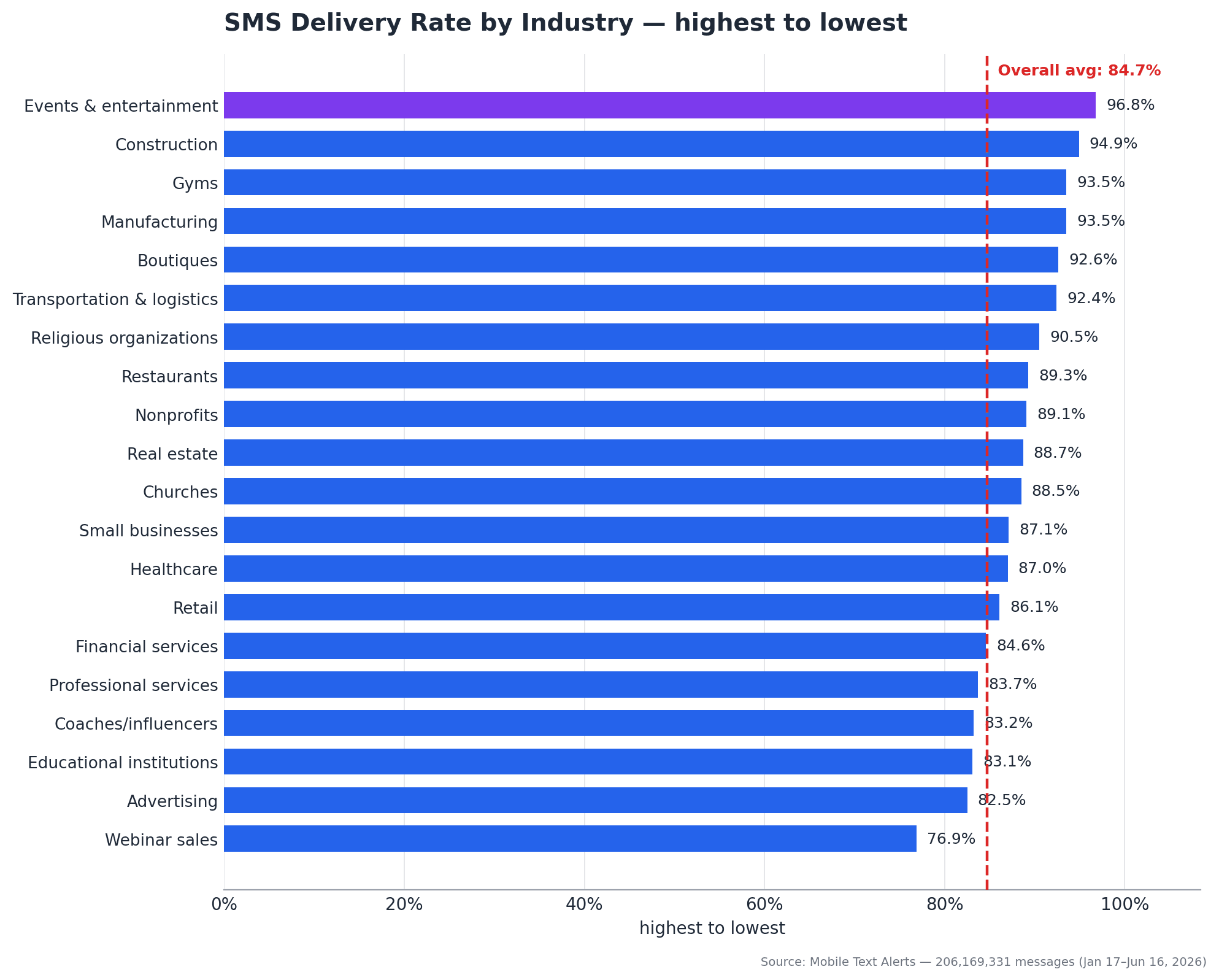
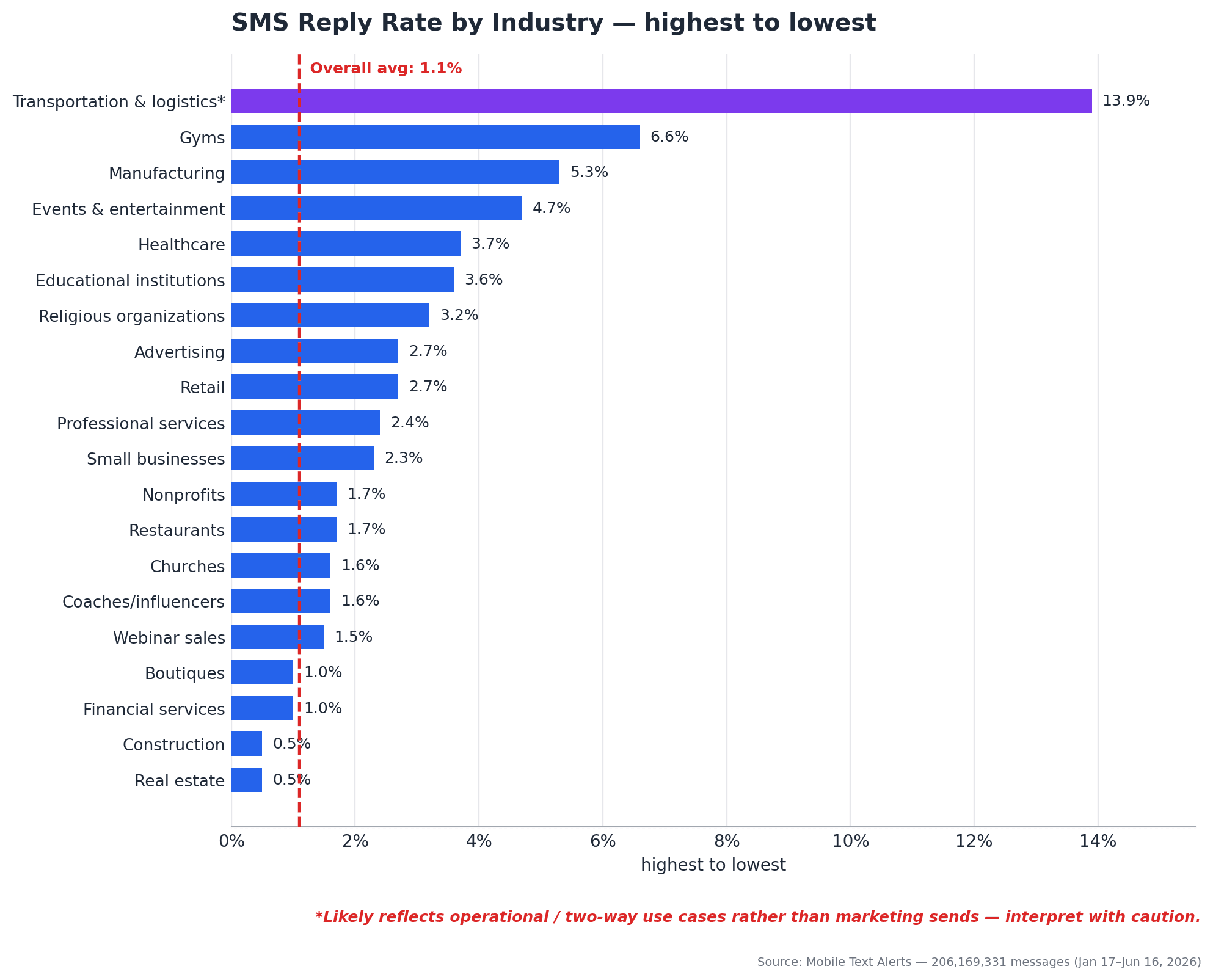
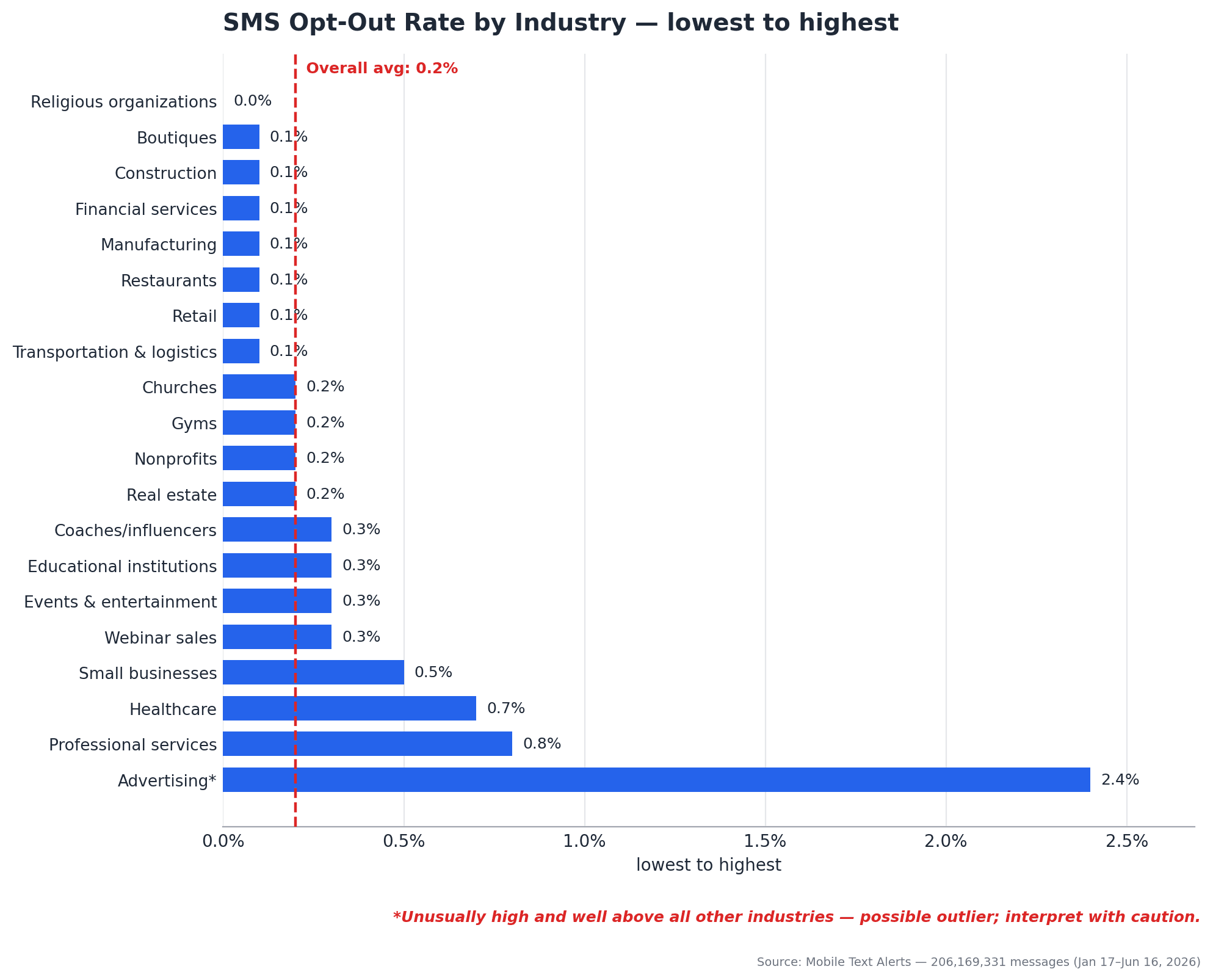
Fascinating, no? (Please don’t say no.) ☺️ And I bid thee now to check out the more specific data + analyses below...
Let’s dive into the different industries.
Is SMS worth it for advertising?
Here’s what was found across 35,511 messages from accounts labeled as “advertising” (Jan 17–Jun 16, 2026):
- Delivery rate: 82.5%
- Reply rate: 2.7%
- Opt-out rate: 2.4%
Analysis:
According to this data, if you’re an advertising business, you can expect to see close-to-average delivery rates on SMS. You can expect decent engagement with above-average reply rates. The opt-out rate is pretty abysmal, however – by far the highest of any industry on this list. (It is so much higher that it’s likely there is an outlier explanation for it, so we probably shouldn’t read too much into it.)
Takeaway:
Be careful. SMS could be worth it for the advertising industry with a good overall reply rate. However, there seems to be a major danger of irritating your audience (although, as mentioned, this high rate is possibly an outlier). Make sure you’re only texting people who* want* to receive messages.
Is SMS worth it for boutiques?
Here’s what was found across 5,328 messages from accounts labeled as “boutique” (Jan 17–Jun 16, 2026):
- Delivery rate: 92.6%
- Reply rate: 1.0%
- Opt-out rate: 0.1%
Analysis:
This is one of the smallest samples in the list, so that should be taken into consideration when looking at the numbers. However, it appears for boutiques, delivery rates are higher than normal (so the vast majority of your audience will likely receive your message). Reply rates are average, but opt-out rates are quite low at about half that of the average.
Takeaway:
Yes, SMS could be worth it for boutiques, since it has such high delivery rates and low opt-out rates. But don’t expect a huge amount of engagement.
Is SMS worth it for churches?
Here’s what was found across 20,773 messages from accounts labeled as “church” (Jan 17–Jun 16, 2026):
- Delivery rate: 88.5%
- Reply rate: 1.6%
- Opt-out rate: 0.2%
Analysis:
Delivery rates for churches were slightly higher than average, and opt-out rates matched the average. Reply rates were slightly higher than average. This would seem to indicate that most, though not* all*, will likely receive your message and you might even see some replies with minimal pushback.
Takeaway:
Yes, SMS could be worth it for churches. Just make sure to have realistic expectations about how many it will actually reach and how much engagement you’ll get.
Side note: churches was the original use case Mobile Text Alerts was created for back in the day in 2011 by our original founder. Oh, how the years go by! (Weeps internal tears of nostalgia. Just kidding.)
Is SMS worth it for coaches or influencers?
Here’s what was found across 29,352 messages from accounts labeled as “coach/influencer” (Jan 17–Jun 16, 2026):
- Delivery rate: 83.2%
- Reply rate: 1.6%
- Opt-out rate: 0.3%
Analysis:
Coaches/influencers can probably expect about average delivery rate. They do seem to see a slightly higher than normal reply rate (which means they seem to be getting some decent engagement). Opt-out rates, on the other hand, were higher than standard.
Takeaway:
Yes, SMS could be worth it for coaches and influencers, with most people receiving your messages and with the potential for decent engagement. Do watch out for higher opt-out potential (i.e., send valuable content to an opted-in list and don’t have too frequent of a cadence).
Is SMS worth it for construction?
Here’s what was found across 96,406 messages from accounts labeled as “construction” (Jan 17–Jun 16, 2026):
- Delivery rate: 94.9%
- Reply rate: 0.5%
- Opt-out rate: 0.1%
Analysis:
Construction saw an outstanding delivery rate and opt-out rate, but low engagement. This could be because construction businesses may be using SMS primarily for sending internal alerts to employees and therefore it would not be expected to have high reply or opt-out rates.
Takeaway:
Yes, SMS is likely worth it as another way to notify employees about information they need to know.
Is SMS worth it for educational institutions?
Here’s what was found across 14,723 messages from accounts labeled as “educational institution” (Jan 17–Jun 16, 2026):
- Delivery rate: 83.1%
- Reply rate: 3.6%
- Opt-out rate: 0.3%
Analysis:
If you’re an educational institution, it seems you can expect about average delivery rates. Your opt-out rates may be slightly higher than average, but you may see really good reply rates. So people are engaging with your messages, even though more are unsubscribing than normal.
Takeaway:
Yes, SMS will likely be worth it since you could see some good engagement. With more engagement does come the potential for more opt-outs, however, so keep that in mind.
Is SMS worth it for events and entertainment businesses?
Here’s what was found across 1,148 messages from accounts labeled as “events and entertainment” (Jan 17–Jun 16, 2026):
- Delivery rate: 96.8%
- Reply rate: 4.7%
- Opt-out rate: 0.3%
Analysis:
Keep in mind that this is the smallest sample we have on this list, which means the data could be skewed. That being said, events/entertainment saw almost perfect delivery rates and a reply rate over 4x better than average. The opt-out rate was slightly higher than average, but that might be expected when you have more people engaging overall.
Takeaway:
Yes, SMS seems promising for events and entertainment businesses (although, as mentioned, this was our smallest sample). You may be able to expect excellent delivery rates, high engagement, and only slightly higher than average opt-outs.
Is SMS worth it for financial services?
Here’s what was found across 6,225 messages from accounts labeled as “financial services” (Jan 17–Jun 16, 2026):
- Delivery rate: 84.6%
- Reply rate: 1.0%
- Opt-out rate: 0.1%
Analysis:
Financial services saw about average delivery and reply rates. Opt-out rates were about half that of the average. All in all, the results were standard, but not bad.
Takeaway:
It’s not a slam-dunk, since you might see average results. But SMS could be worth it since it reaches so many people and you likely won’t be irritating your audience.
Are we still going? Sure are! If you’ve read everything thus far, send me a LinkedIn DM with the word REPORT and I’ll give you an Easter egg.
Is SMS worth it for gyms?
Here’s what was found across 7,014 messages from accounts labeled as “gym” (Jan 17–Jun 16, 2026):
- Delivery rate: 93.5%
- Reply rate: 6.6%
- Opt-out rate: 0.2%
Analysis:
The data showed that gyms saw both excellent delivery rates and excellent reply rates, so they apparently reached almost all their audience and saw really good engagement. Opt-out rates were right on par with average.
Takeaway:
Yes, SMS appears to be worth it for gyms. It seems you’ll be able to reach almost all of your audience with high delivery rates, and you’ll be able to get some great engagement.
Is SMS worth it for healthcare?
Here’s what was found across 76,733 messages from accounts labeled as “healthcare” (Jan 17–Jun 16, 2026):
- Delivery rate: 87.0%
- Reply rate: 3.7%
- Opt-out rate: 0.7%
Analysis:
Healthcare-related businesses and organizations saw slightly higher than average delivery rates. They also saw really good reply rates. But opt-out rates were 3.5x higher than average – so audiences seem to be engaging more than typical but also a large number are not finding messages valuable.
Takeaway:
Be careful. It seems worth it to try SMS for healthcare since it can yield such high engagement rates. But you’ll need to make sure that you’re sending messages your audience actually cares about so that you don’t drive up opt-out rates.
Is SMS worth it for manufacturing?
Here’s what was found across 16,270 messages from accounts labeled as “manufacturing” (Jan 17–Jun 16, 2026):
- Delivery rate: 93.5%
- Reply rate: 5.3%
- Opt-out rate: 0.1%
Analysis:
It seems with manufacturing, you can expect (1) high delivery rates, (2) high reply rates, and (3) low opt-out rates. In other words, according to this data, apparently people will see your messages, will respond to your messages, and they will continue to want to receive your messages. There don’t appear to be any negative indicators here.
Takeaway:
Yes, manufacturing appears to be worth it across all the measures listed (delivery, replies, and opt-outs).
Is SMS worth it for nonprofits?
Here’s what was found across 114,965 messages from accounts labeled as “nonprofit organization” (Jan 17–Jun 16, 2026):
- Delivery rate: 89.1%
- Reply rate: 1.7%
- Opt-out rate: 0.2%
Analysis:
Nonprofits found higher than average delivery rates. They also saw slightly higher than average reply rates. So messages are getting seen and there is some general engagement. Opt-out rates were in line with our benchmarked average.
Takeaway:
Yes, it appears nonprofits could benefit from incorporating SMS. They’ll be able to reach a large portion of their audience and can likely expect some replies, although the results may not be outstanding.
Is SMS worth it for professional services?
Here’s what was found across 13,814 messages from accounts labeled as “professional services” (Jan 17–Jun 16, 2026):
- Delivery rate: 83.7%
- Reply rate: 2.4%
- Opt-out rate: 0.8%
Analysis:
The delivery rate for professional services was slightly lower than average, but reply rate was over twice the average, so decent engagement there. The most significant number was the opt-out rate, which was 4x more than the 0.2% benchmark.
Takeaway:
Be careful. It could be worth it to try SMS since you might see some good engagement. But your messages will likely need to be very relevant so that your audience doesn’t get tired of receiving them.
Is SMS worth it for real estate?
Here’s what was found across 501,806 messages from accounts labeled as “real estate” (Jan 17–Jun 16, 2026):
- Delivery rate: 88.7%
- Reply rate: 0.5%
- Opt-out rate: 0.2%
Analysis:
If you’re in real estate, the data above indicates that you’ll likely see a pretty good delivery rate, and your opt-out rates will be average (so, not bad). However, reply rates may be quite low – people don’t seem to be engaging with these messages.
Takeaway:
Is SMS worth it for real estate? It depends on your purpose. If you’re just sending notifications and expecting no reply back, you’ll probably see good delivery rates and not-too-high opt-outs. But you may not see good success if you’re trying to engage in two-way connections.
Is SMS worth it for religious organizations?
Here’s what was found across 17,281 messages from accounts labeled as “religious organization” (Jan 17–Jun 16, 2026):
- Delivery rate: 90.5%
- Reply rate: 3.2%
- Opt-out rate: 0.0%
Analysis:
Religious organizations by and large saw excellent delivery rates. The vast majority of people are receiving these messages. These organizations also saw reply rates that were almost 3x higher than average, and opt-outs were almost non-existent.
Takeaway:
Yes, SMS appears to be worth it for religious organizations as a whole. It seems you’ll see high delivery rates, good engagement, and your messages apparently won’t irritate most of your audience.
Is SMS worth it for restaurants?
Here’s what was found across 81,941 messages from accounts labeled as “restaurant/cafe” (Jan 17–Jun 16, 2026):
- Delivery rate: 89.3%
- Reply rate: 1.7%
- Opt-out rate: 0.1%
Analysis:
The data seems to show that restaurants can expect higher delivery rates than normal. Their reply rates are also slightly higher, although not outstanding, so people are engaging with the messages. Opt-out rates appear to be about half of the average.
Takeaway:
Yes, SMS may be worth it for restaurants as there are positive indicators across all three data points above. That being said, the data isn’t positive to a stunning extent, so you don’t want to have unrealistic expectations.
You’re still here, eh? You overacheiver you! 😉 If you’ve stuck it out this far send me a LinkedIn DM with the word REPORTMASTER and I'll give you anudder Easter egg.
Is SMS worth it for retail?
Here’s what was found across 66,476 messages from accounts labeled as “retail and consumer products” (Jan 17–Jun 16, 2026):
- Delivery rate: 86.1%
- Reply rate: 2.7%
- Opt-out rate: 0.1%
Analysis:
Retail data showed mostly average delivery rates, but reply rates that were over twice the benchmarked average, indicating message engagement. Opt-out rates were quite low as well, which is somewhat surprising for a sales-oriented industry such as retail.
Takeaway:
Yes, it seems that retail could benefit from using SMS. You’ll likely get a decent delivery rate and solid engagement without coming across spammy to your customers.
Is SMS worth it for small businesses?
Here’s what was found across 261,164 messages from accounts labeled as simply “small business” (Jan 17–Jun 16, 2026):
- Delivery rate: 87.1%
- Reply rate: 2.3%
- Opt-out rate: 0.5%
Analysis:
Small businesses as a “catch-all” category of miscellaneous brands saw a slightly higher delivery rate than average. They also saw decent engagement with over twice the reply rate of our benchmark. The area of weakness was the opt-out rate, which was 2.5x more than the average.
Takeaway:
Be careful. It could be worth it to try SMS for your small business since you may get some good engagement. But make sure your audience has clearly opted in (so that they are truly expecting your messages), that your messages provide real value, and that you’re not sending too many.
Is SMS worth it for transportation and logistics?
Here’s what was found across 378,477 messages from accounts labeled as “transportation or logistics” (Jan 17–Jun 16, 2026):
- Delivery rate: 92.4%
- Reply rate: 13.9%
- Opt-out rate: 0.1%
Analysis:
The transportation and logistics industry by and large saw the most positive results of any other industry. Delivery rates were excellent. Reply rates were so high as to raise eyebrows, and opt-out rates were about half the average. (Caveat: these results are likely because of a large number of affiliated operational use cases within our customer base that are much more likely to expect/warrant a reply, rather than marketing blasts.)
Takeaway:
Yes, although the data does seem to be skewed toward a particular use case, SMS appears to be worth it for transportation and logistics. It seems to be an excellent way for this industry to reach and interact with people.
Is SMS worth it for webinar sales?
Here’s what was found across 94,959 messages from accounts labeled as “webinar sales” (Jan 17–Jun 16, 2026):
- Delivery rate: 76.9%
- Reply rate: 1.5%
- Opt-out rate: 0.3%
Analysis:
Accounts marked as “webinar sales” saw significantly lower delivery rates. So fewer people are actually seeing these messages. The reply rates were about average (slightly higher), but the opt-out rate was higher than average.
Takeaway:
Be careful. Messages regarding webinar sales may apparently only reach 3/4s of your audience and may see higher opt-outs. You can, however, see some engagement.
Author Bio

Sam Pelton is the content director for Mobile Text Alerts, an SMS service that gives businesses an easier way to reach customers and audiences. He has 12 years of experience working with the texting platform in the areas of customer support, quality assurance testing, content creation, copywriting, and marketing strategy. He’s also a father of 6 and loves a good (bad) dad joke.
Is SMS worth it? - FAQ
Is SMS marketing worth it?
Yes, SMS marketing appears to be worth it for most industries, according to our customer data on delivery rates, reply rates, and opt-out rates above.
What's a good SMS reply rate?
Across all our customer industries the average reply rate was 1.1%, although this will certainly vary by industry.
What’s a good SMS opt-out rate?
Across all our customer industries the average opt-out rate was 0.2%.
What’s a good SMS delivery rate?
The average delivery rate for our customer industries was 84.7%. (Messages may fail for several reasons, such as invalid numbers or messages blocked by phone carriers.)